
The Euclid Consortium wishes everyone joyful holidays at the end of 2025!
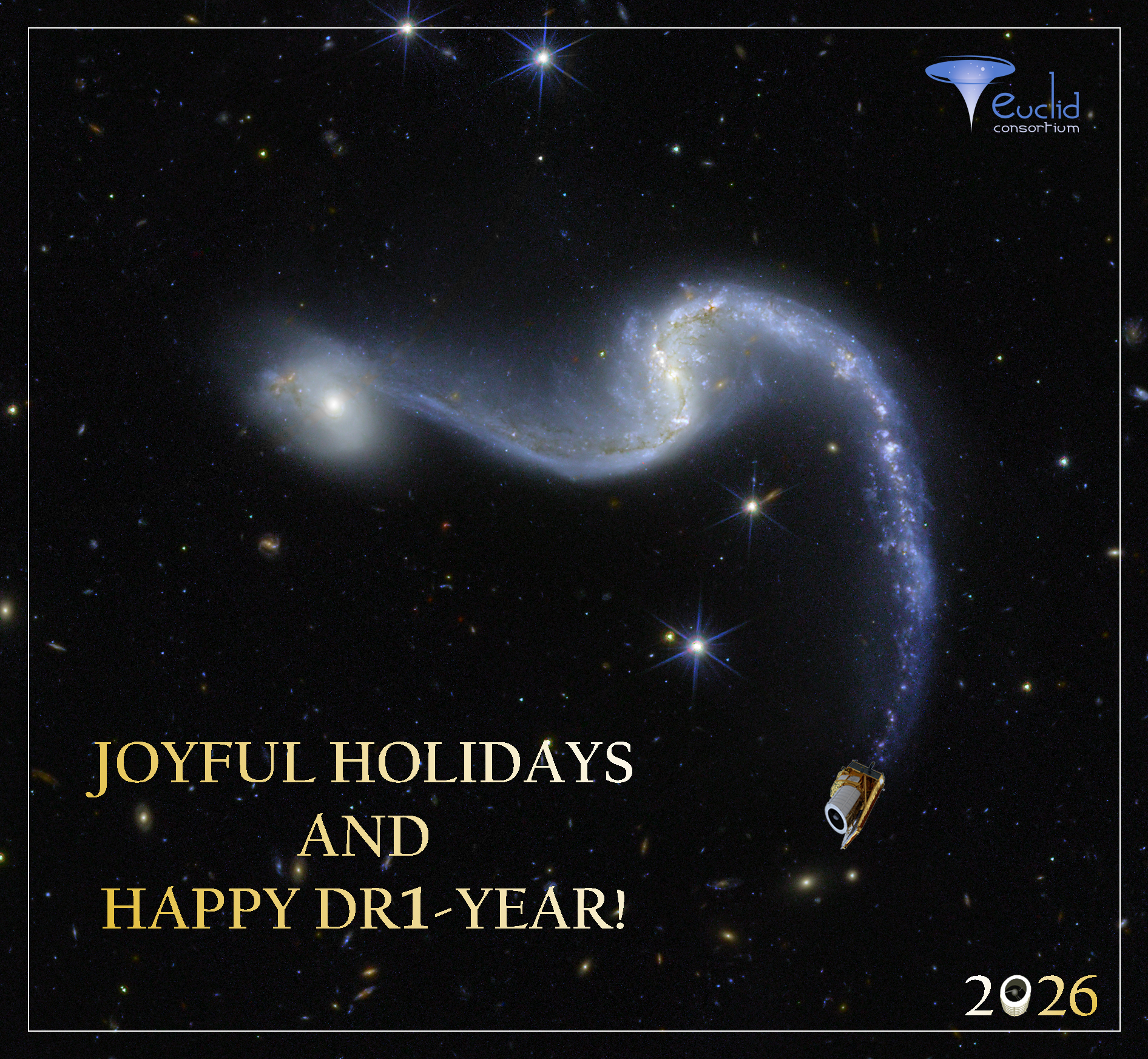
NGC 646 is a large barred spiral galaxy located in the constellation Hydrus. It was discovered in 1834 by the British astronomer John Herschel and has recently been observed by the Euclid space telescope. The galaxy is moving away from us at a speed of about 7,927 km/s, which corresponds to a distance of roughly 115 megaparsecs, or about 374 million light-years.
In images, NGC 646 appears close to a smaller galaxy to its east, called PGC 6014. Despite uncertainties in the distances measurements, the asymetry of NGC 646 and the absence of other nearby galaxies suggest that these two galaxies, separated by a distance of about 4 million-light-years, have been interacting.
Although these galaxies may seem very far, they are actually quite close compared to the billions of galaxies that Euclid will observe during its six-year mission. By the end of 2026, the European Space Agency (ESA) and the Euclid Consortium will release the first year of its observations, corresponding to 1,900 square degrees. These images will show hundreds of thousands of galaxies in exquisite detail, marking an important milestone in the history of astrophysics. Along with many other scientific investigations, this unprecedented dataset will help scientists deeply understand how galaxies form and evolve, including why such barred galaxies become more common as the Universe ages, or how such interactions between galaxies influence their shapes and activity.


