Press Release: Discovery of the Two Most Distant Quasars Ever Observed
2026-07-06, Euclid Consortium
PDF version of press release text
Euclid Space Telescope Shatters Cosmic Record: Discovery of the Two Most Distant Quasars Ever Observed
Today, the Euclid Consortium announces the discovery of 31 new quasars at redshifts between 6.6 and 7.8, including the two most distant quasars ever observed. The findings, published in Astronomy & Astrophysics, mark a significant step forward in our understanding of the early Universe, just 600–800 million years after the Big Bang.
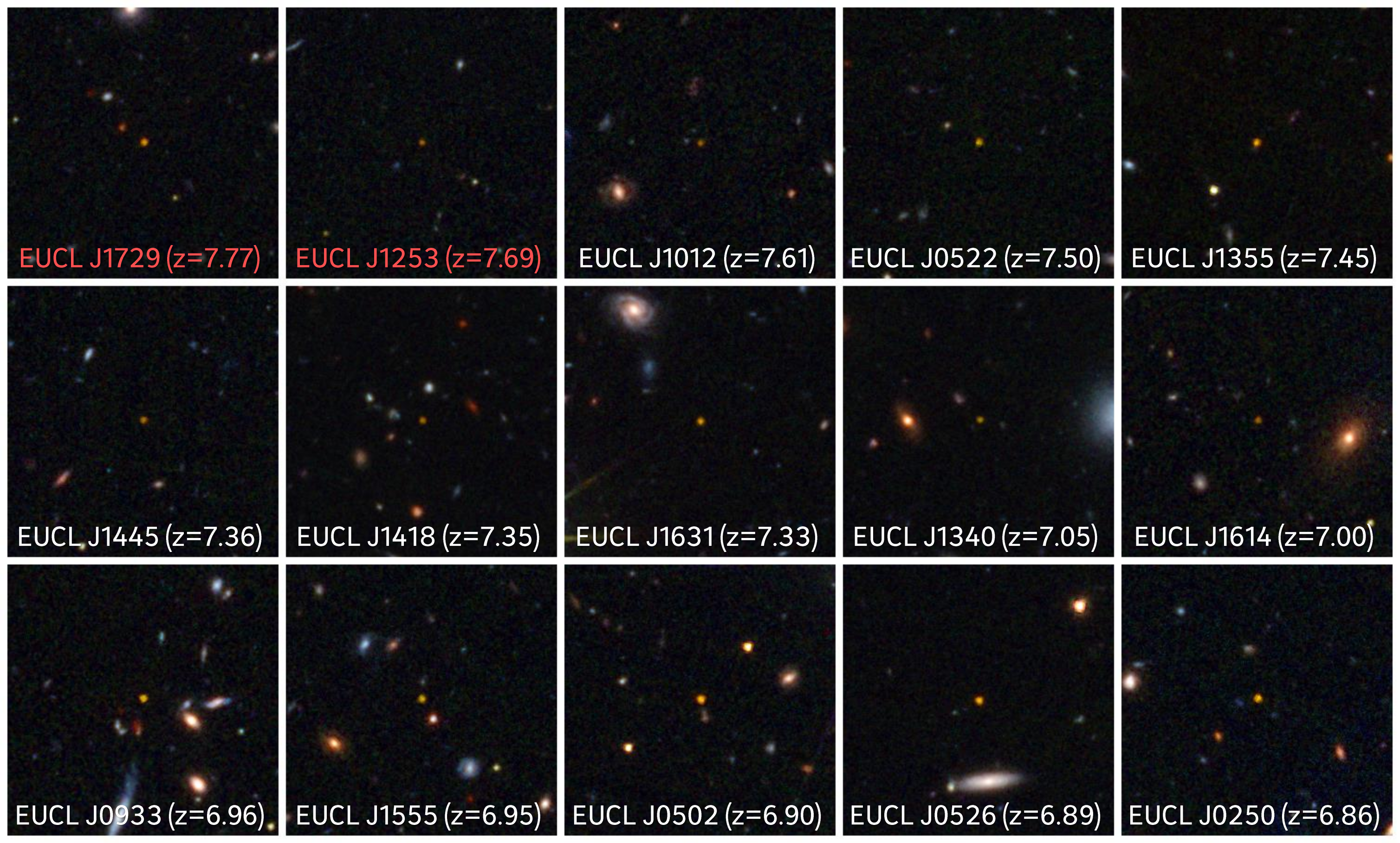
15 of the 31 quasars discovered, the small dots at the center of each tile, with their names and redshift (z). Credit : ESA/Euclid/Euclid Consortium/NASA, image processing by the Euclid Science Ground Segment and Antoine Basset (CNES)
The Euclid Consortium warmly thanks Daming Yang, Antoine Basset and Jean-Charles Cuillandre for their help in the creation of the communications material for this news.
About quasars
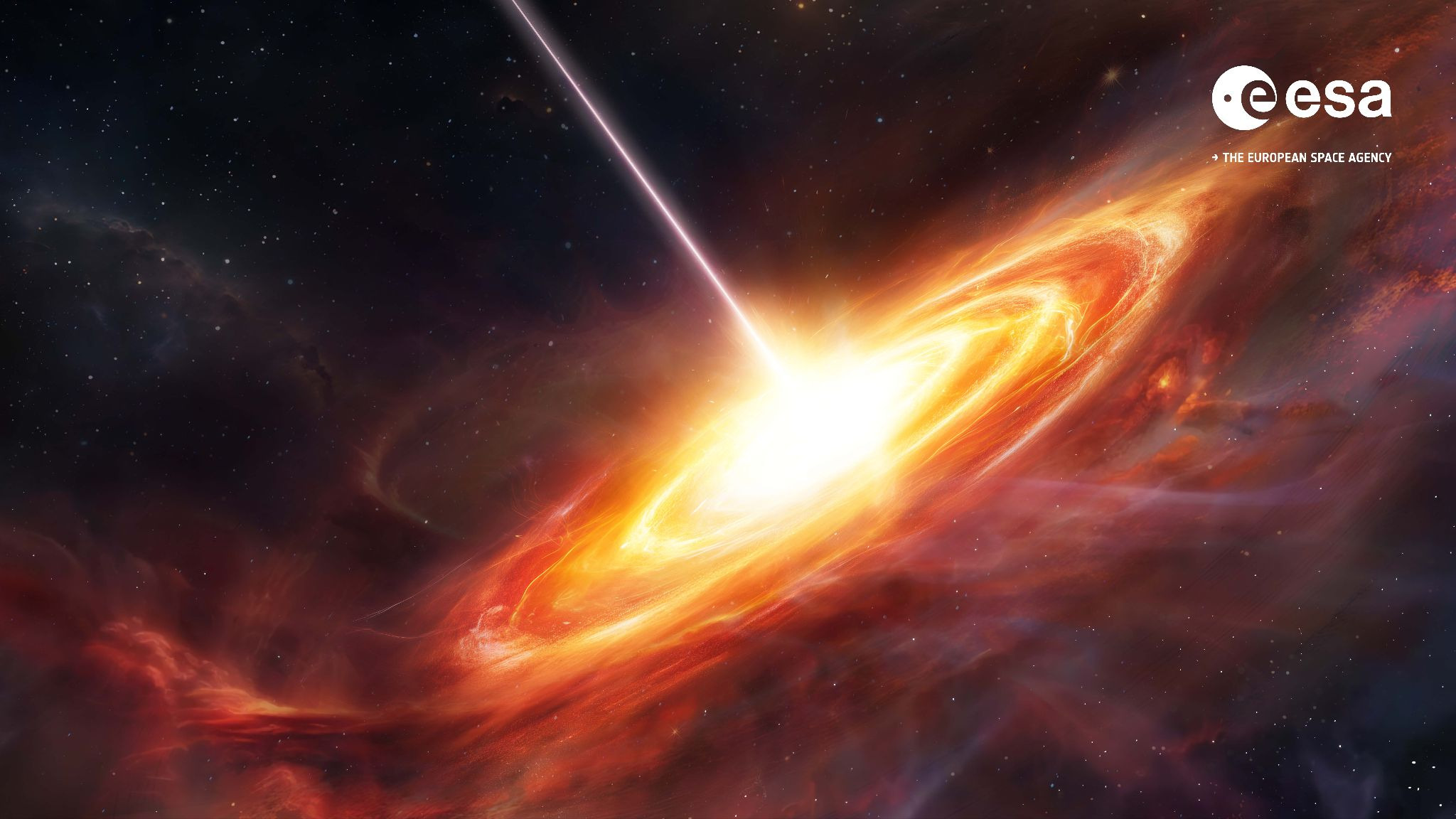
Quasars are among the brightest, most energetic objects in the Universe, powered by supermassive black holes devouring matter at the center of galaxies. Their extreme luminosity makes them visible across cosmic distances, acting as beacons that illuminate the epoch of reionization, a pivotal phase when the first stars and galaxies ionized the dark, neutral hydrogen fog filling the early Universe.
Yet, quasars at redshifts beyond 7 (when the Universe was less than 5% of its current age) are exceedingly rare and difficult to detect. Their light is stretched into the near-infrared by cosmic expansion, falling into a wavelength range where Earth’s atmosphere glows brightly, drowning out faint signals. Until now, only nine quasars had been confirmed at z > 7 – they are now 23. “How did billion-solar-mass black holes form in a few hundred million years? How did they influence the reionization of the universe? What do their host galaxies look like and how do the black holes affect them? With only a few quasars known beyond redshift seven, we simply cannot answer these questions. Finding more of them at such distances – and pushing to even greater distances – is the only way forward.” says Daming Yang, PhD student at Leiden Observatory and first author of the paper.
A Revolutionary Hunt: Euclid’s Wide-Eyed Search
The Euclid Space Telescope, launched in 2023, is transforming quasar discovery with its unprecedented combination of depth and sky coverage. Unlike previous surveys, Euclid’s Near-Infrared Spectrometer and Photometer (NISP) and Visible Camera (VIS) scan thousands of square degrees with exquisite sensitivity. Reaching magnitudes as faint as 24.5 in the near-infrared, Euclid’s data is deep enough to detect quasars 10 to 100 times fainter than those found in earlier wide-field surveys, allowing the elaboration of a wider and more representative catalogue of quasars from this epoch of the Universe.
The Euclid Consortium scientists employed a multi-pronged approach. First, machine Learning algorithms analyzed Euclid’s optical and near-infrared band images, identifying candidates with the telltale dropout signatures in spectra of high-redshift quasars. “The exquisite Euclid data, processed by the Euclid Science Ground Segment, enabled us the application of advanced selection techniques that have resulted in an extremely efficient survey, with a success rate in confirming quasars of ~30%. This might not seem like a lot, but it is 10 times better than previous efforts!” adds Francesco Guarneri, postdoctoral researcher at the University of Hamburg.
Ancillary Data from the Hyper Suprime-Cam (HSC), Dark Energy Survey (DES) and the LOFAR Two-metre Sky Survey (LoTSS) then allowed to sharpen the selection by confirming the Lyman-alpha break, a sudden cut-off in light caused by neutral hydrogen absorbing shorter wavelengths. Spectroscopic confirmation was obtained thanks to a ground-based follow-up with Keck, Magellan, and the Large Binocular Telescope (LBT) that confirmed 31 quasars from the early universe.
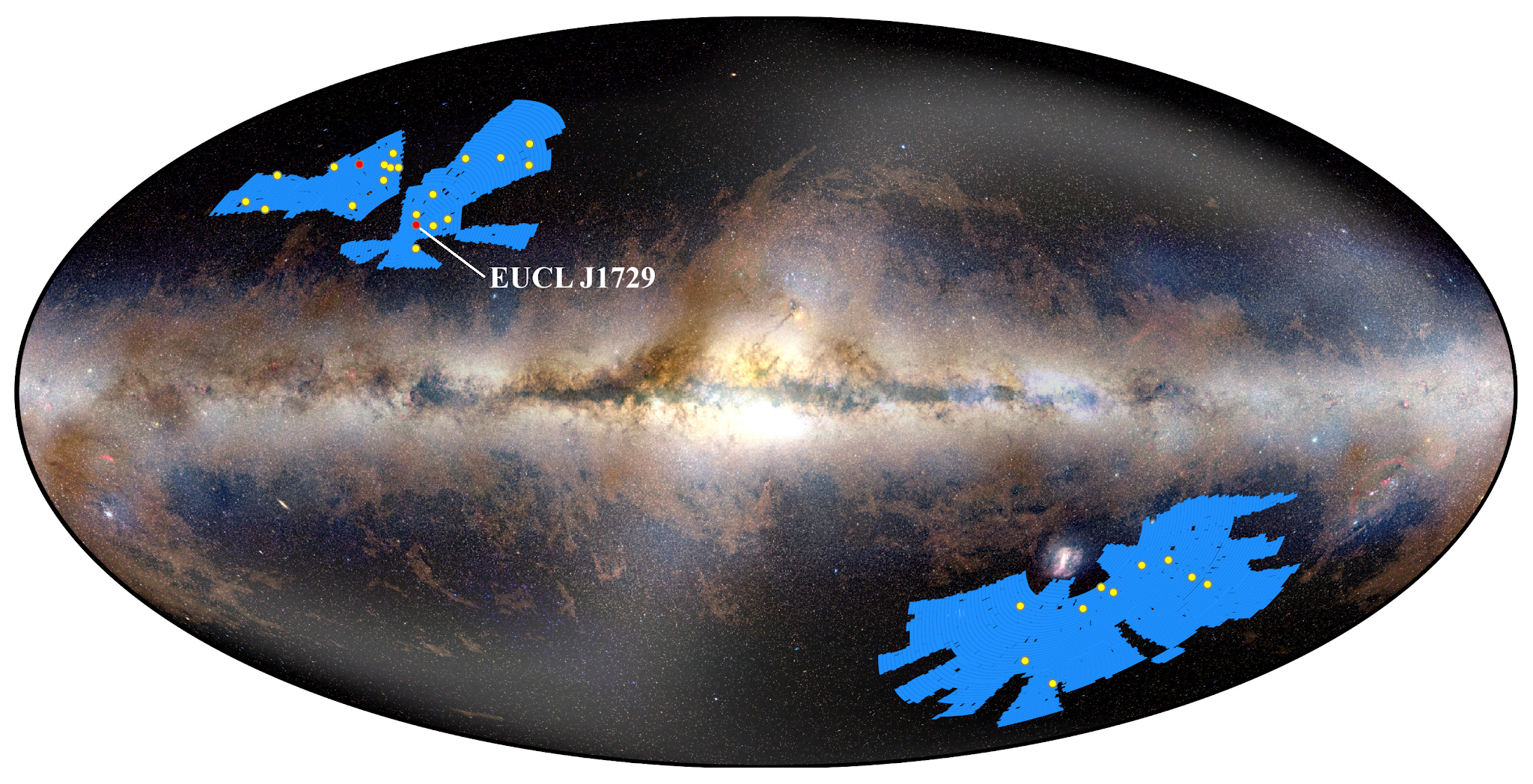
They include the new record-holder: EUCL J172902.75+641018.1 at z ≈ 7.77, corresponding to a Universe age of about 670 million years, surpassing the previous record by 15 million years! “This is truly exciting. These luminous quasars, shining from deep within the reionization era, the last major transition in our Universe’s history, offer invaluable insights into how the cosmos emerged from darkness and how the earliest supermassive black holes formed.” says Jinyi Yang, Assistant Professor at University of Michigan.
With only one year and a half of Euclid data, this discovery is just the beginning. The full 6-year survey is expected to uncover hundreds more high-redshift quasars, including the first z > 8 quasars. “Discovery is only the first step. Observing these objects across the full electromagnetic spectrum using data from other facilities allows us to characterize the environments of these quasars and their host galaxies. Further observations on the second most ancient quasar showed that it is embedded in a dusty, gas-filled galaxy that is rapidly forming new stars, hinting at what the host galaxy of an early supermassive black hole may be like!” says Silvia Belladitta, postdoctoral researcher at MPIA and lead author of a first follow-up paper published at the same time.
Future milestones for the Euclid mission
The next Euclid data release (DR1) is scheduled for late 2026. This unprecedented dataset, corresponding to one year of Euclid observations, will represent – and by far – the largest map of the Universe ever produced from space in both infrared and visible light. Its unique combination of wide sky coverage and high resolution will also drive breakthroughs in many other fields of astrophysics, with discoveries on the nature of dark matter and dark energy expected in 2027.
The Euclid Consortium
The Euclid Consortium, in partnership with the European Space Agency (ESA) and the National Aeronautics and Space Administration (NASA), has designed and built the instruments of the Euclid space telescope. It has also developed and currently operates the data pipeline, the system responsible for processing and organizing data from the telescope. This mission aims to map the extragalactic sky over a period of six years, providing unique data that offer new insights into dark energy and dark matter. Launched on July 1st, 2023, the telescope successfully began its cosmological survey on February 14th, 2024.
The Euclid Consortium comprises more than 2000 members, from more than 300 laboratories in 15 European countries, plus Canada, Japan, and the United States, covering various fields in astrophysics, cosmology, theoretical physics, and particle physics.


ESA Q2 release webstory
Find ESA’s story here: https://www.esa.int/Science_Exploration/Space_Science/Euclid/Euclid_discovers_the_most_ancient_quasar_in_the_Universe
Press inquiries
For more information, or press inquiries to the Euclid Consortium, please email menard@iap.fr.
Euclid Consortium Press Contacts page includes national contacts.