
Euclid covers a much larger area in every image compared to previous space telescopes, all while resolving details. The Hubble Space Telescope has a roughly 2x larger mirror than Euclid and can still resolve structures twice as fine, but over a much smaller area: It could in principle carry out Euclid’s Wide Survey, but it would take 100s of years instead of only six. So what happens when combining Hubble’s eye for detail and Euclid’s field of view? Something incredible is the result.
The Cat’s Eye Nebula is the result of gas blown out from a massive star late in its life. It’s a so-called ‘planetary nebula’, unrelated to planets, but this was not known when William Herschel discovered this object almost exactly 240 years ago. It looked roundish – like our planets – through early telescopes.
Hubble and Euclid today are able to photograph images with 20–30 times finer resolution than Herschel’s telescope at the time. They show something magnificent, an intricate and network of gas filaments and complex larger shock fronts where the ejected gas impacts into interstellar matter and a fragmented ring of previous ejecta from the same star. This is Euclid’s view:
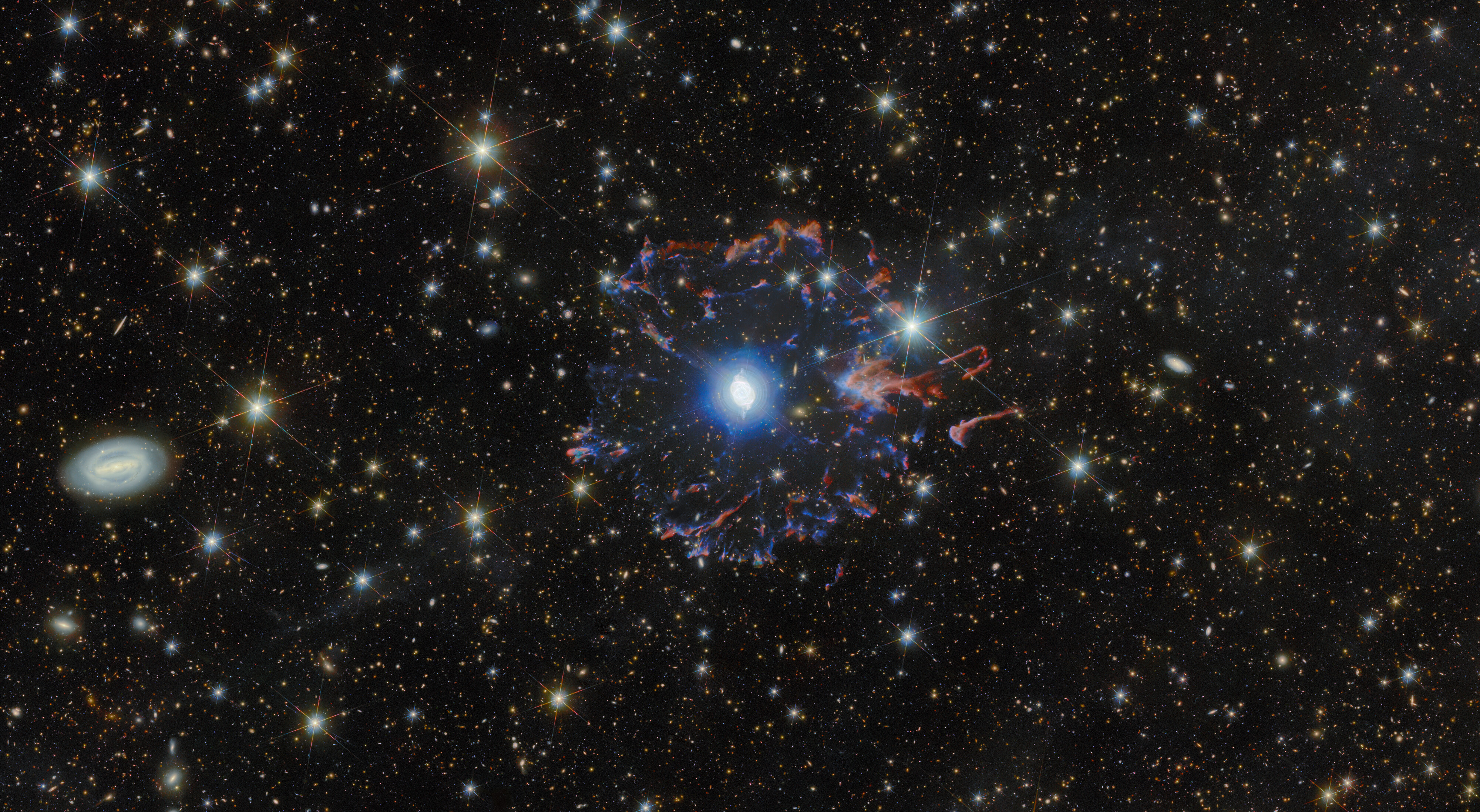
Credit: ESA/Hubble & NASA, ESA Euclid/Euclid Consortium/NASA/Q1-2025, J.-C. Cuillandre & E. Bertin (CEA Paris-Saclay), Z. Tsvetanov
License: CC BY-SA 3.0 IGO
At 4300 light-years distance, this star and its planetary nebula sit not too far away in our own Milky Way. Looking further around the Cat’s Eye Nebula (or NGC 6543, with it’s catalogue number in the New General Catalogue of celestial objects), Euclid observes some other stars in our Milky Way in front of a myriad of other galaxies. Larger and smaller, more nearby or very distant, one can for many see spiral arms or other structure, some sit more isolated, others group in galaxy clusters. This image was taken as part of Euclid’s Deep Survey, where the same 53 deg² are observed 40–50 times over the course of Euclid’s mission.
To zoom further in, we turn to Hubble, to get an even better view of the very center:
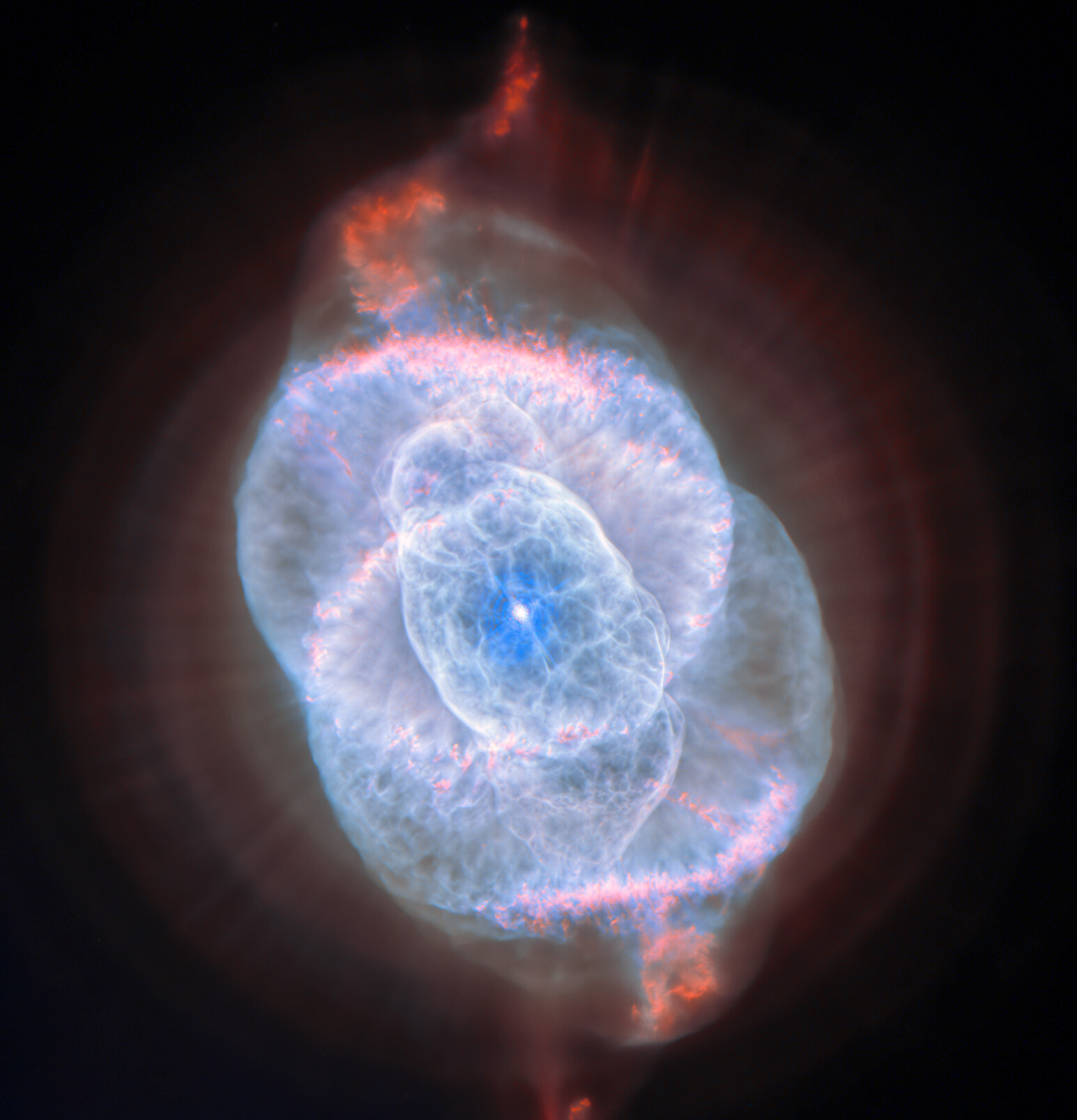
Credit: ESA/Hubble & NASA, Z. Tsvetanov
License: CC BY 4.0 INT
Overall, this “ESA/Hubble Picture of the Month” with its Euclid contribution is a great example of the power that comes from combining different telescopes and instruments across ESA’s fleet to show – and study – objects and scenes that was never possible before. Here’s the very relaxing flight through our galaxy towards this Cat’s Eye. The full release, background information, full-res images, and the link to more video animations are available at ESA’s Hubble site.
Credits: ESA/Hubble & NASA, ESA Euclid/Euclid Consortium/NASA/Q1-2025, J.-C. Cuillandre & E. Bertin (CEA Paris-Saclay), Z. Tsvetanov, G. Anselmi, E. Slawik, N. Risinger, N. Bartmann (ESA/Hubble), M. Zamani (ESA/Hubble)
Music: Tonelabs – The Red North (www.tonelabs.com)


