
Euclid is a space mission planned, built, and operated by more than 2000 scientists and engineers across Europe and other countries. In Portraits of Euclideans we showcase the people behind the mission.
In this portrait: Ismael Tereno, Euclid Survey Scientist
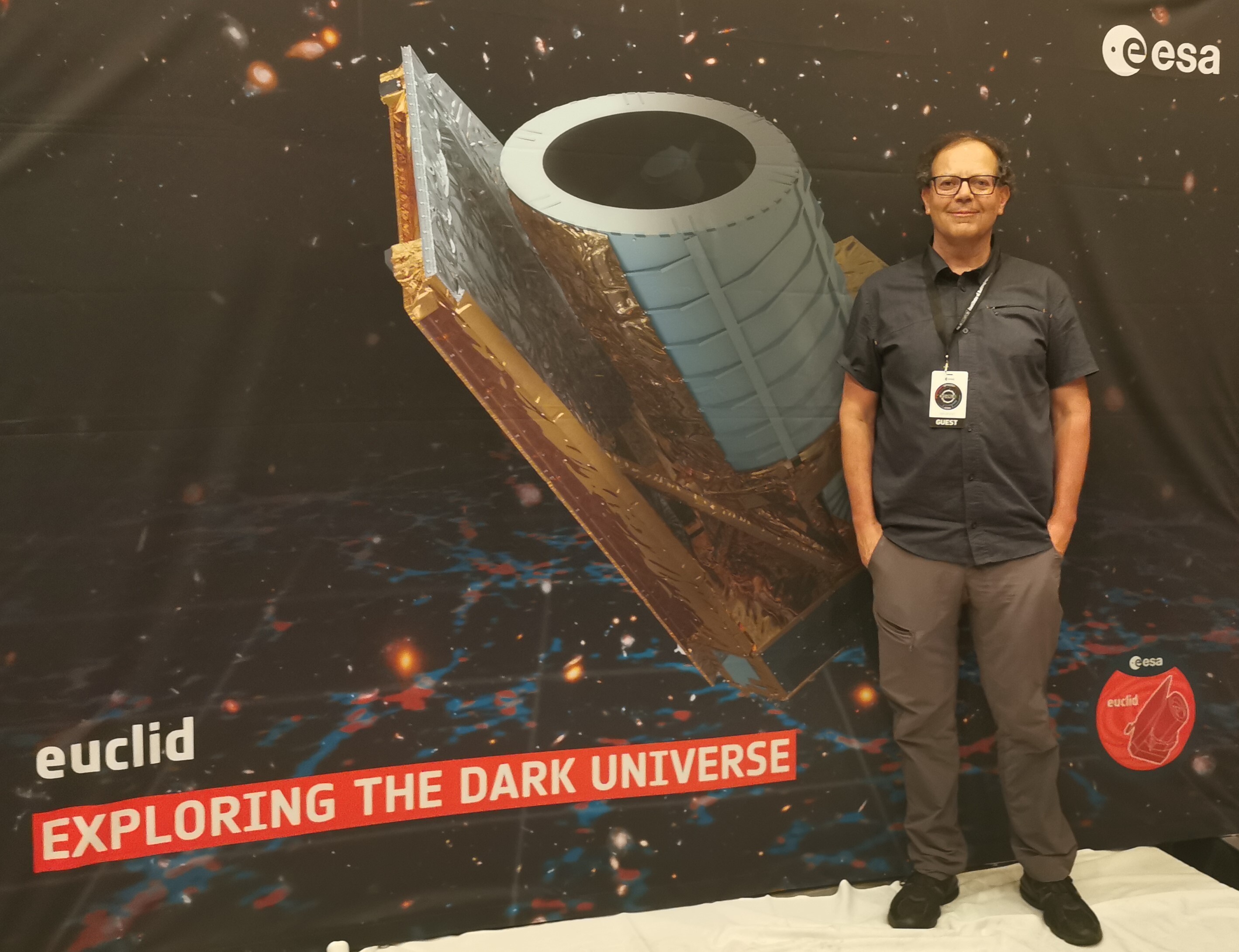
- Can you tell us something about your background?
I grew up and made all my school and university studies in Lisbon, Portugal. Growing up, family travels thanks to my father’s work in an airline company were also important moments for my development. At school I liked all subjects, both science and humanities, but especially mathematics, and had a hard time deciding which college course to take. After a master’s degree specialized in general relativity, I saw in the year 2000 a newspaper article on the recent first cosmic shear measurements. The connection between gravitational theory and the detection of astrophysical structures raised my interest, and it was something new for me because at the time observational cosmology was non-existent in Lisbon. I contacted one of the lead authors of the research paper, Yannick Mellier, proposing to become his PhD student in Paris. This marked my entrance in the field of weak lensing and of a long-time collaboration with Yannick, that would become the EC lead ten years later.
- What is your role in the Euclid Consortium?
I am the EC Survey Scientist. I became a Euclidian in 2012, after returning to Lisbon, and after taking part in the negotiation process that led to Portugal becoming a Euclid member country. I joined the weak lensing and theory science working groups, but most importantly joined a new small group, the survey group, led by Roberto Scaramella, dedicated to the implementation of the Euclid survey, in other words to the construction of the sequence of observations that the Euclid telescope executes. In the early years we were involved in the definition of avoidance regions, evaluation of backgrounds, and proposals for the Deep fields locations, based on science requirements. Then we defined a strategy to fill the sky with Euclid observations, according to system constraints and limitations. We can then build observing plans that fulfill calibration requirements on cadences and targets. A survey plan needs to fit, within the duration of the mission, all the targets and a maximum of wide survey area coverage, to optimize the science goals while being compliant with all requirements. The resulting sequence of observations and slews, known as the reference survey definition (RSD), is constructed with a dedicated software and is delivered to the science operations center (SOC/ESA) that transforms it into an operational survey. After 12 years in the survey group, I replaced Roberto as EC Survey Scientist in December 2024.
- What is the most interesting or exciting thing about your job?
It is both interesting and stressful to have the responsibility to make choices that have an impact in the whole mission, and it is definitely exciting to know that at this moment Euclid is observing a specific point in the sky because of these decisions. Especially in the operations phase, it is very important to collect all inputs that are relevant for survey replanning. This is a collaborative effort, with feedback from system and instrument behaviour, data processing, science performance, calibration updates, mission updates, and regular joint EC/ESA meetings. The writing of the document describing the RSD in detail, organizing all the relevant information, is also an interesting part of the job. It is also rewarding to provide this fundamental Euclid product to the community.
- What excites you or interests you most about Euclid specifically?
It is very impressive to see all the pieces that need to fit together to build and operate such an ambitious experiment designed for a single goal : to discover the nature of dark energy and dark matter. In my daily work as survey scientist I got more distant from this science goal, then when I was a PhD student and post-doc working in cosmology and weak lensing. But in return, I gained a much broader view of the huge collaborative effort involved in its achievement. On the other hand, it is also reassuring that the scientific success of the mission does not lie only on this single objective. In fact, the stability, high-quality and size of the images required for that objective enables, as a by-product, a wide scope of science.
- What do you think will be the most valuable contribution of Euclid ?
Euclid is the first dark energy space mission of its generation. In this sense, it is a pioneering mission and it will be difficult to have the final word on the dark Universe. It would be very exciting if it could provide a direct, model-independent, measure of the dynamics of the Universe. A model-dependent constraint would be less exciting, since there are so many theoretical possibilities that the degeneracies prevent a definitive answer. The cartographic aspect, in other words, the tomographic map of the large-scale structure of the Universe across cosmic times is also a contribution that interests me, even though it may have less science value. In the end, the main contribution may come from non-cosmology science. The detection of huge numbers of astrophysical objects, and in many cases with better signal-to-noise than in current catalogs, will improve the statistics and our knowledge of the properties of a wide variety of extra-galactic objects, and probably some apparently rare classes of objects will cease to be rare.
- Why did you become a scientist and how?
Growing up, I had a romanticized image of the scientist, probably in part from reading Jules Vernes’s books. The scientist was presented as someone that, usually working in isolation, makes thorough observations and keeps notes, gathering empirical and theoretical knowledge, trying to find patterns and hints that with creativity will lead to discoveries. I think I related with that profile and always assumed I would be a scientist without thinking much about it. Naturally, reality is different, and this description does not exactly fit the activities of a Euclid scientist working in a large collaboration.
- What do you do for fun?
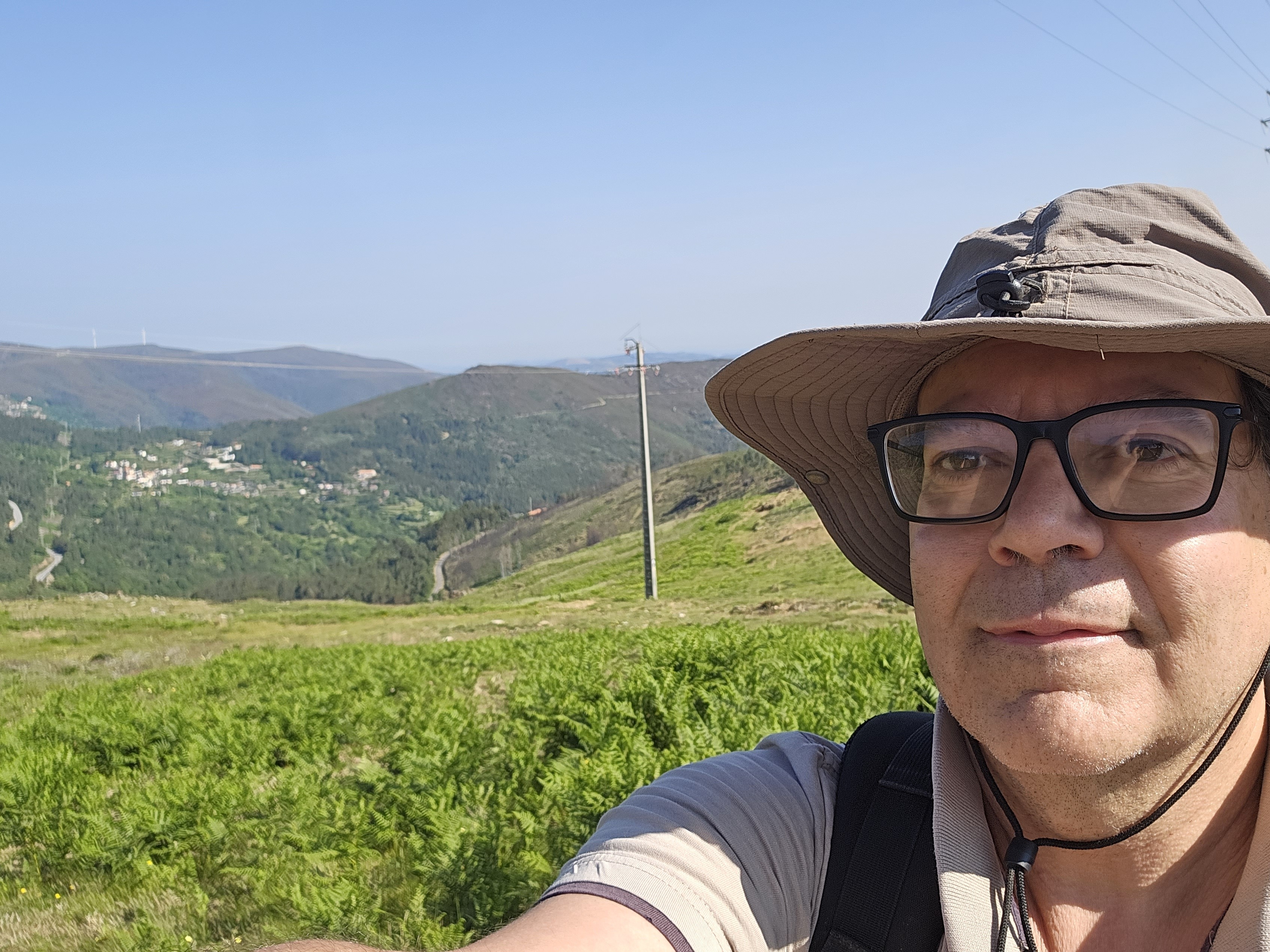
I would say my main hobby is doing small explorations. It may be hiking in the nature, paying attention to the geographical features; for example whenever I have time I walk another section of the Portuguese coastline, up and down the cliffs, continuing from where I left last time. It may be exploring a city, its neighborhoods, museums, street markets, second-hand bookshops. Or just staying home reading a book. I am also a big fan of the beach, especially if there are waves and the water is not too warm.


