
Space Warps is back! Do you want to join forces with Euclid Consortium scientists and discover gravitational lenses that no human has ever seen before? We’re announcing the next Space Warps Citizen Science campaign with Euclid data – now previewing images from Data Release 1. Here is how to become part of the project.
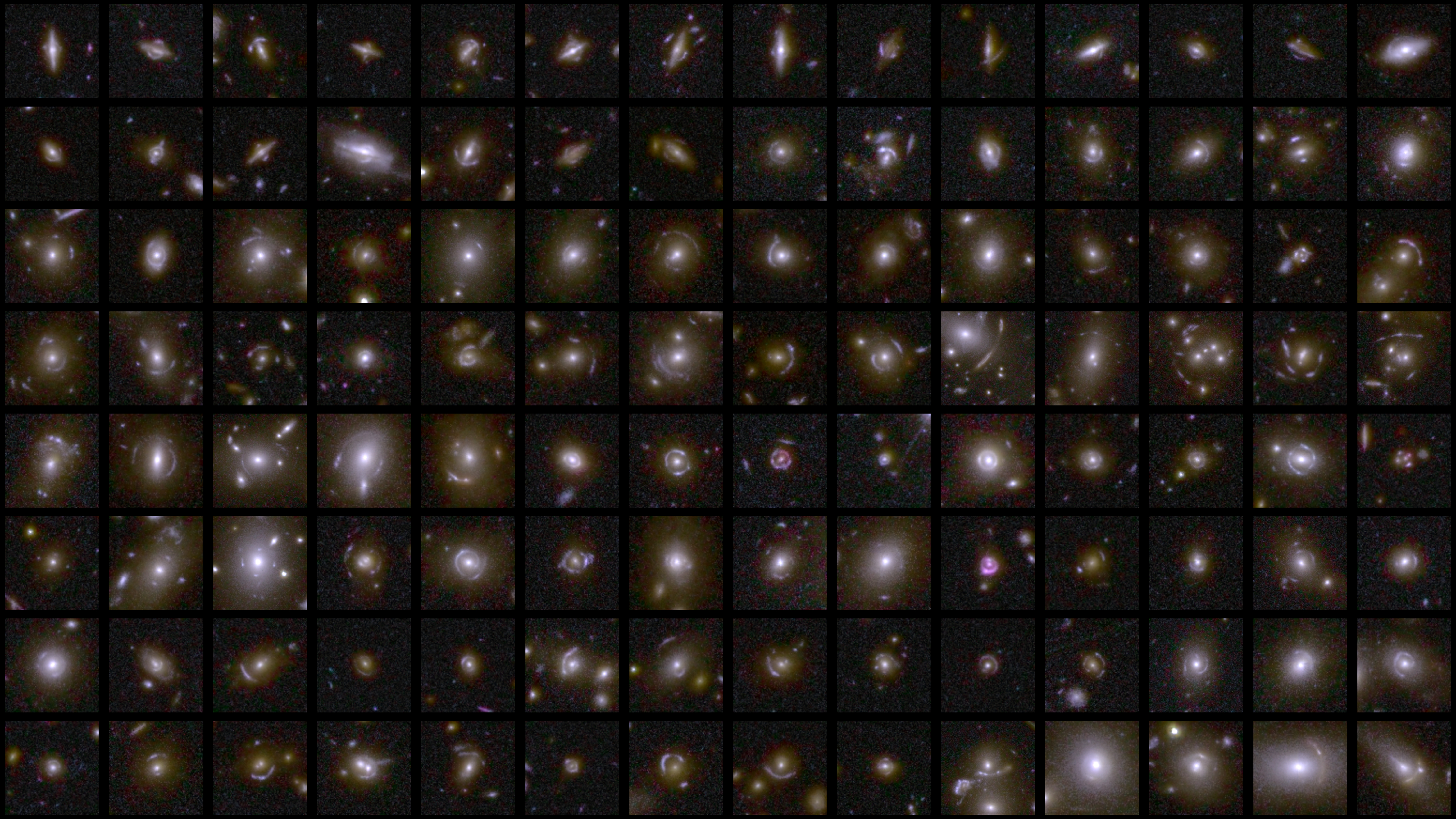
A new campaign of Space Warps on the Zooniverse platform is now inviting the public to help discover strong gravitational lenses in the Data Release 1 (DR1) from the Euclid mission. These rare cosmic phenomena occur when massive galaxies bend light from objects behind them, creating distorted arcs or rings and offering a powerful way to study dark matter and dark energy.
Our first Space Warps campaign took place at the end of 2024, searching through the very first Euclid data for gravitational lenses. Please have a look at our 2024 blogpost to learn more about the background and science.
The scale of this new effort is unprecedented. Volunteers will examine around 300,000 high-quality images that have been pre-selected by artificial intelligence from a dataset of about 72 million galaxies in Euclid’s DR1, that corresponds to one full year of observations. This dataset is roughly 30 times larger than the first Space warps dataset, based on the early-2024 Q1 data release. From this, scientists expect to identify more than 10,000 new strong gravitational lenses – far exceeding the total number discovered in the past several decades.
Early results already show the potential of this approach: 500 lenses were found in just 0.04% of Euclid’s data, most of them previously unknown. By combining human input with AI filtering, the project aims to rapidly expand the catalog of known lenses while giving participants early access to cutting-edge space images. Ultimately, these discoveries will help map hidden matter in galaxies and improve our understanding of how the Universe has evolved.
Strong gravitational lenses also provide a direct way to measure the total mass of galaxies and clusters, including invisible dark matter, by observing how strongly they bend light. Studying these systems across different epochs allows scientists to trace how cosmic structures have grown and how the expansion of the Universe has changed over time, offering additional clues about the influence of dark energy.
Participate in the Euclid science analysis: Space Warps Euclid
Links: See also ESA’s story


