
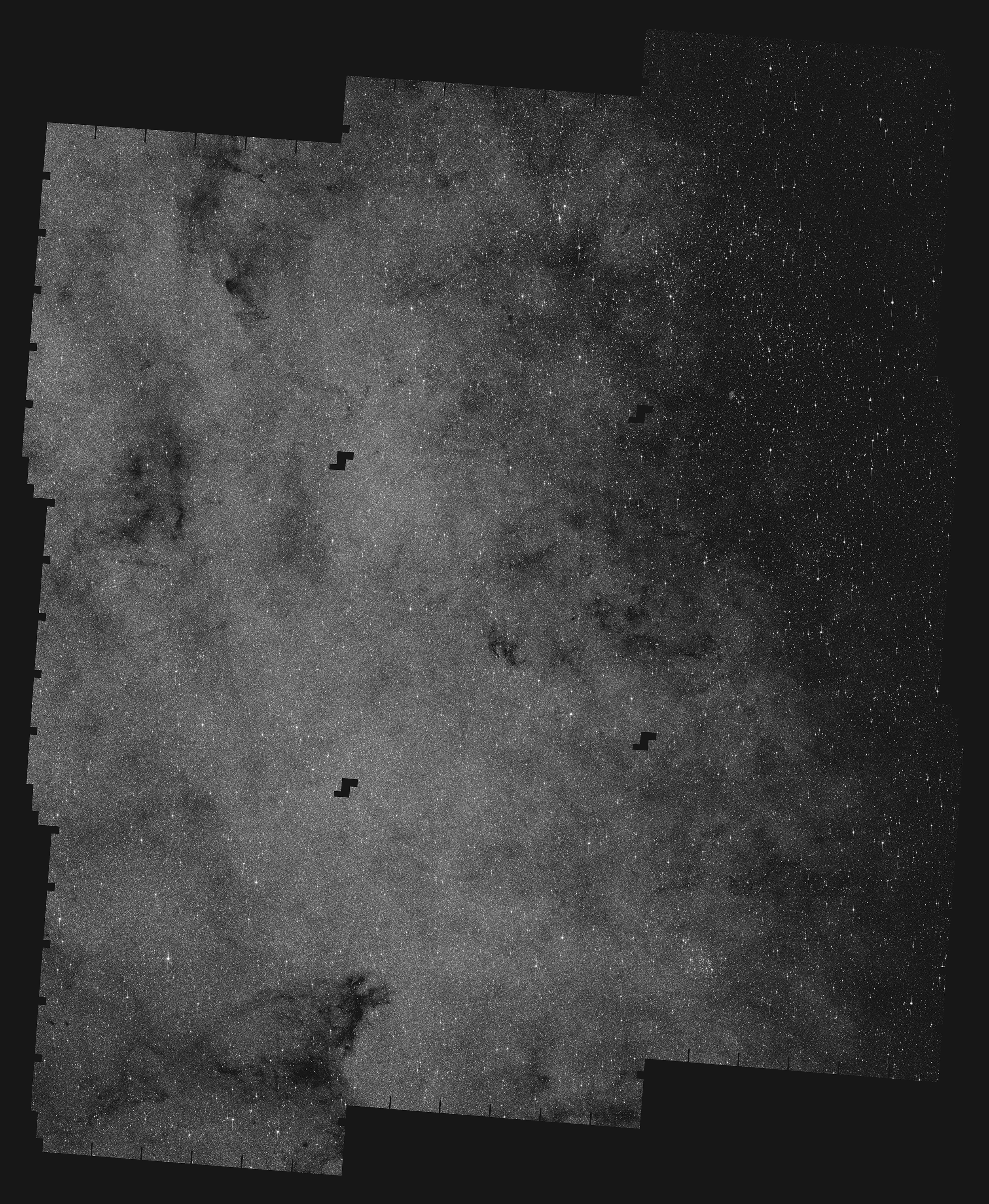
On 23 March 2025, the Euclid space telescope targeted an unusual location: a region near the Galactic Centre, capturing an exceptionally deep, wide-field, and high-resolution view of the Milky Way’s inner bulge. Over roughly 24 hours, the telescope observed nine contiguous fields, covering a total of 4.8 square degrees, capturing the images of roughly 60 million stars in total. Now the images and catalogues are made public to the world – we take the opportunity to peek behind the curtain to see what makes this image so special and which challenges had to be overcome.
Taken by Euclid’s VIS instrument only, this image shows part of the bulge of our Milky Way. It was observed as part of Euclid’s Q2 data release (see press release and the Q2 overview page). Showing a very dense stellar region, very differently from Euclid’s ‘normal’ Wide Survey, it was still mainly processed by the OU-VIS team of the Euclid Science Ground Segment (SGS) – who had to stretch their capabilities beyond the usual. In this article, we briefly outline the work of the scientists, both researchers and engineers, behind this incredible auxiliary Euclid observation.
The Science Ground Segment – Euclid’s data processing backbone
To process the ~100GB of data that Euclid sends to Earth everyday, the Euclid Science Ground Segment (SGS) is organized in different teams in charge of a precise part of the data processing. Their responsibilities are diverse, but they all have a common goal: jointly transform Euclid raw images into calibrated images, ready for scientific use, meeting Euclid’s stringent quality standards. From decompressing the satellite’s images received by ESA’s deep space antennas to creating the shear maps by measuring the gravitational lensing effects, or counting galaxy clusters at different epochs of the Universe, algorithms used in the Euclid pipeline are extremely numerous, complex and computationally intensive. They mobilize about half of the resources of the Euclid Consortium, across a dozen countries.
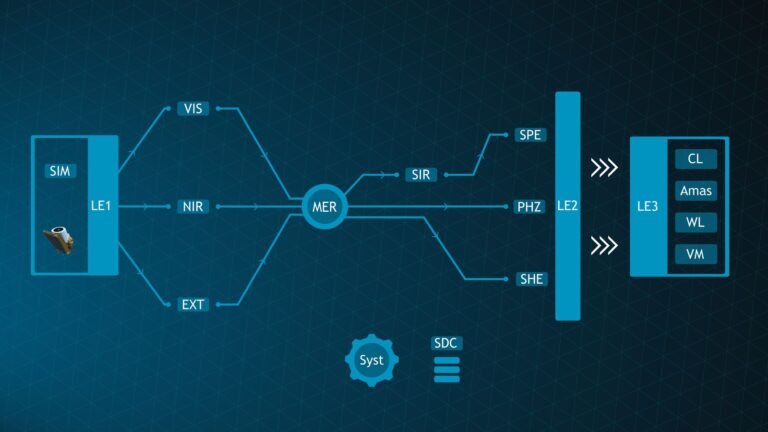
The products of the main pipeline operated by the Euclid SGS are used by most scientists in the Euclid Consortium. However, the main pipeline – primarily designed to detect, isolate, and measure distant galaxies – is not well suited for extremely crowded fields containing tens of millions of stars in one image. Although specialized, auxiliary pipelines already exist, such as a pipeline to identify transient events like supernovae and a low-surface-brightness pipeline dedicated to faint extende objects like nearby and dwarf galaxies, they address specific scientific needs and processing strategies. None were appropriate for handling a dense stellar field like the EGBS.
Olivier Herent, engineer at the Institut d’astrophysique de Paris (IAP), was involved in the processing of the image: “It was indeed a rather stressful period for the team, as we couldn’t get the astrometry to converge properly despite all the attempts we made.” This was bad news: it would mean one couldn’t get the images properly aligned on the sky. Why? The EGBS exposures differ significantly from those of the nominal Euclid mission, since they target regions near the Galactic center with extremely high stellar density.
Sylvain Mottet, OU-VIS engineer at IAP, explains: “This high density has several consequences. First, the Gaia reference catalog used for astrometry and photometry had to be filtered, keeping only stars with magnitudes between 18.5 and 19.0 to reduce data volume and processing time. Second, cosmic-ray detection and masking become less reliable: many stars are falsely identified as cosmic rays. Adjusting detection parameters helps mitigate this, but cannot fully eliminate false detections.”
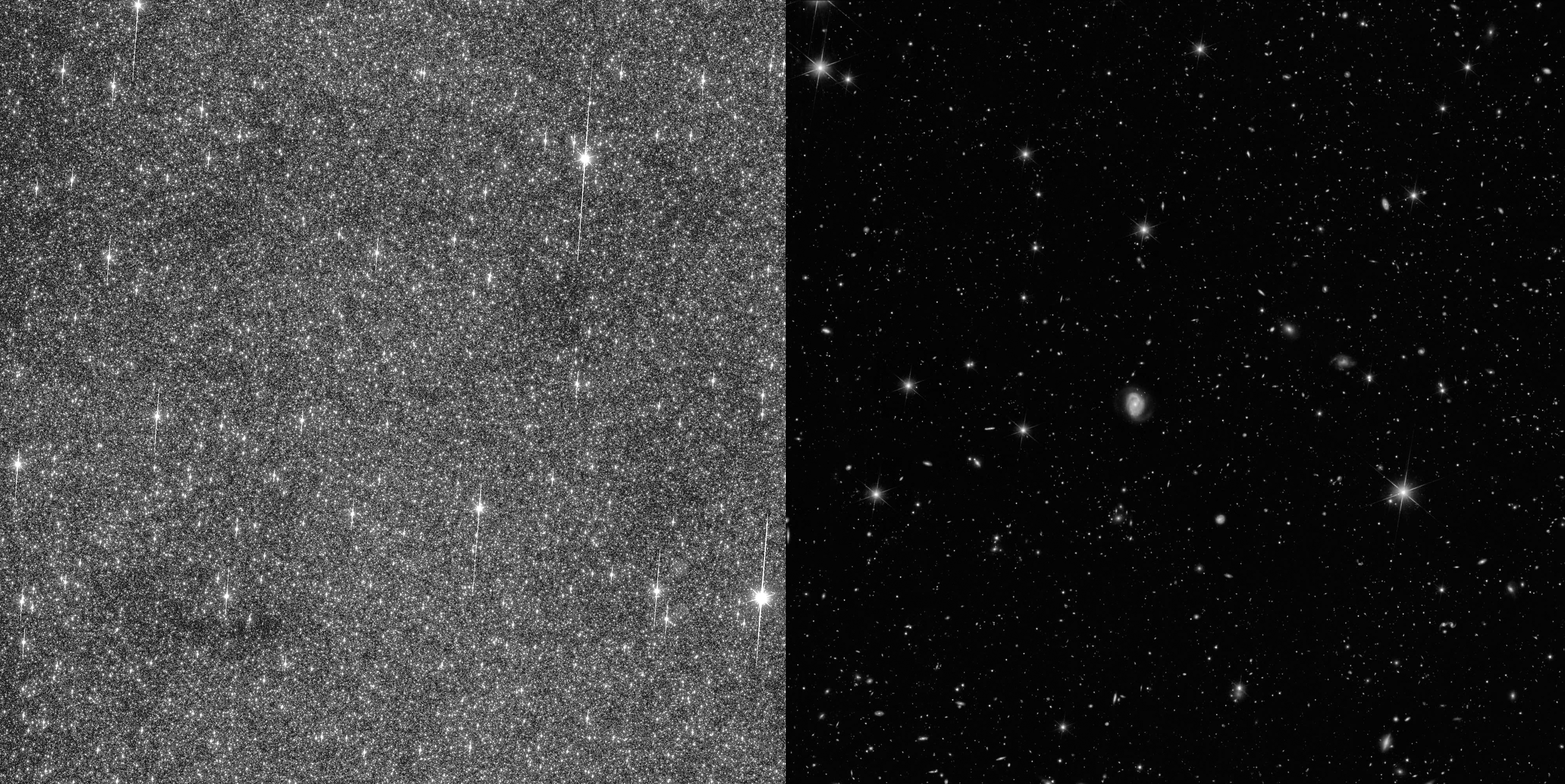
Credits: ESA/Euclid/Euclid Consortium/NASA, image processings by the Euclid Science Ground Segment, J.-C. Cuillandre (CEA Paris-Saclay), G. Anselmi.
The vertical streaks are caused by extremely bright stars that saturate the pixels they fall on. The excess charge overflows into adjacent pixels above and below, which in turn become saturated and continue spreading the charge along the column, forming a vertical line. This effect occurs mainly in the vertical direction because charge transfer in a CCD is much easier along pixel columns than across them: columns are separated by barriers that are hard to cross, while charges are read out by shifting them row by row, allowing them to propagate more readily vertically than horizontally.
Processing such crowded fields is also more computationally demanding, requiring increased runtime and resources for all catalog-related programs, and in some cases minor code changes to limit memory usage. Additionally, because of its proximity to the Galactic center, the EGBS fields exhibit strong and highly variable interstellar extinction. Gas and dust clouds dim stars and redden their colors, enhancing instrumental effects that depend on stellar color.
Finally, astrometric reconstruction is more difficult: the high source density increases the number of false matches between detected sources and the reference catalogue. To address this, the astrometry algorithm parameters were adjusted – particularly by increasing the number of iterations – to improve outlier rejection and achieve a reliable solution.
“While going through the astrometry code in detail, I noticed that the algorithm’s default number of iterations was very low. I changed this parameter just to test it – and suddenly it worked!” concludes Olivier Herrent.
Microlensing search for exoplanets
This EGBS observation is part of the Euclid ‘Quick Release’ Q2 campaign (check out what was published for the Q1 data release), which consists of small data releases between the main ones, called ‘DR’. These observations, though auxiliary, are nonetheless important for the Euclid mission, as they highlight the telescope’s unprecedented ability to deliver exquisite data across a wide range of astrophysical research areas. Moreover, the Q2 data truly serve the exoplanets science as they will allow, in the near future, dozens of precise mass measurements of known cold planets and support the characterization of future discoveries by NASA’s Nancy Grace Roman Telescope. They will also enable dynamical studies of the Galactic disk at low latitude, the search for asteroids, and improved measurements of planetary masses.
“Before starting my thesis and focusing on exoplanets, I had read a lot about Euclid and was really eager to work with this satellite. I never thought I’d have the chance to do so while studying exoplanets! The EGBS data is the first space telescope data I’ve worked with; so it’s both very exciting and challenging. Fortunately, in addition to Euclid’s Exoplanets Science Working Group, the OU-VIS team at the IAP has done an exceptional job and really guided me through my first steps with the data”, says Manon Gilles, PhD student at IAP.
This observation was initially proposed by Jean-Philippe Beaulieu, astrophysicist at the Institut d’astrophysique de Paris and member of the Euclid Consortium exoplanet team. “I thought about using the incredible power of Euclid’s combination of wide field of view and high resolution for exoplanet science even before its acceptance as a mission at ESA, in 2011.”
Since 2003, about 200 planets have been discovered through microlensing. They are all located toward the center of the Galaxy, at distances between 1 and 7 kiloparsecs, and orbit their host stars at separations of a few astronomical units. High-angular-resolution observations with Euclid make it possible to reobserve these systems and obtain precise mass measurements. Two notable examples from the past of this observation technique are OGLE-2005-BLG-390Lb, a 5 Earth-mass planet and the first super-Earth ever discovered, and OGLE-2013-BLG-341Lb, a 1.7 Earth-mass planet, that are both cold super-Earths.
“For OGLE-2005-BLG-390Lb, I was the lead author of the original study, so reobserving it 20 years later to learn more about the planet is particularly meaningful. Given its cold environment, this planet can be compared to Hoth from the Star Wars movie: The Empire Strikes Back!” adds Jean-Philippe.
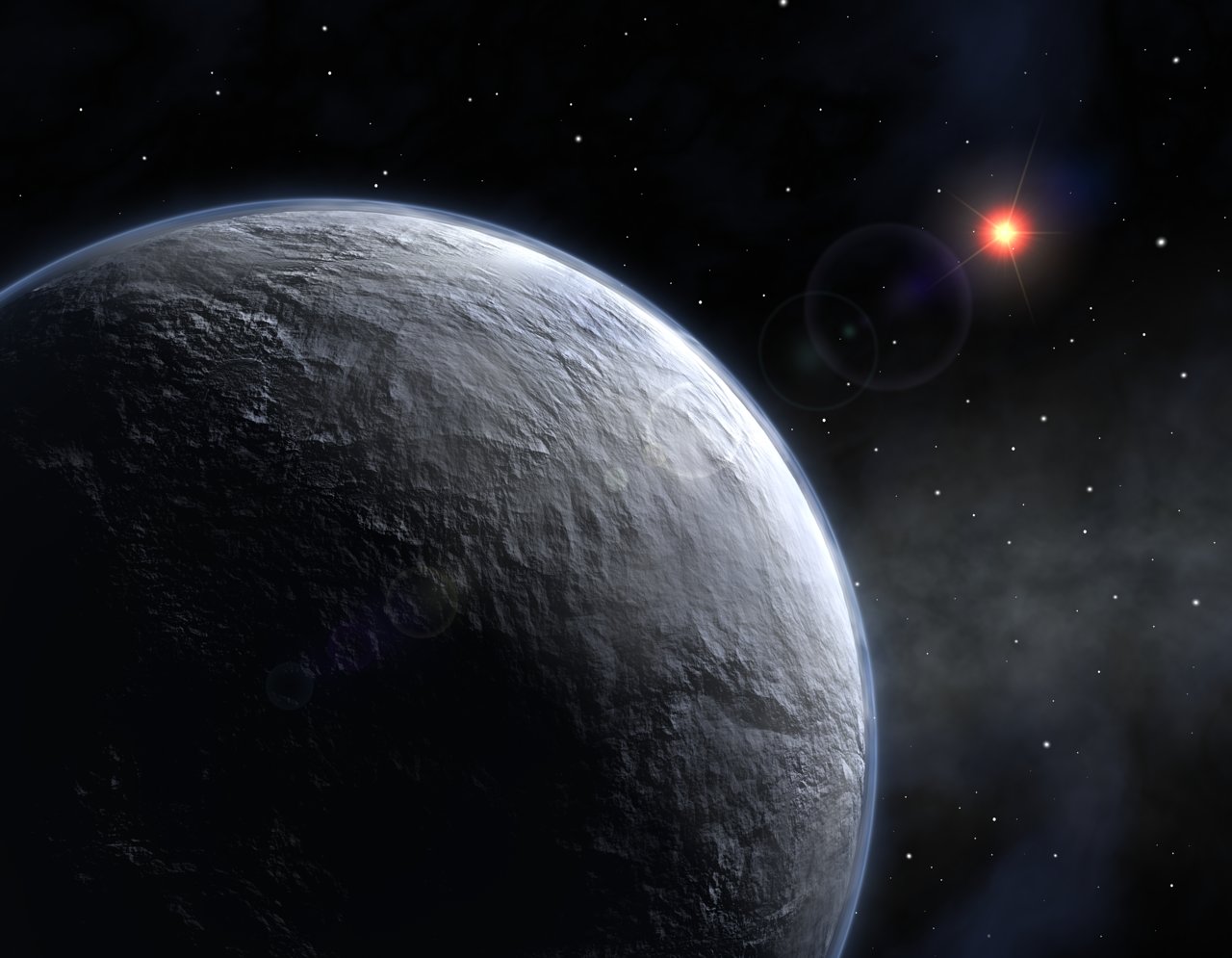
Using a network of telescopes scattered across the globe, including the Danish 1.5-m telescope at ESO La Silla (Chile), astronomers discovered a new extrasolar planet significantly more Earth-like than any other planet found so far. The planet, which is only about 5 times as massive as the Earth, circles its parent star in about 10 years. It is the least massive exoplanet around an ordinary star detected so far and also the coolest. The planet most certainly has a rocky or icy surface. Its discovery marks a groundbreaking result in the search for planets that support life.
This microlensing technique is reminiscent of the well known use of weak and strong gravitational lensing phenomena that are central to Euclid science. “More broadly, Euclid represents a meeting point between cosmologists and exoplanet scientists – two traditionally distinct communities!” concludes Jean-Philippe.
This survey and release have been made possible by the dedicated work of the Exoplanet Science Working Groupe: Etienne Bachelet (Université Marie et Louis Pasteur/UTINAM, SWG-lead), Clément Ranc (IAP/Sorbonne University), Himanshu Verma (LSU), Eamonn Kerrins (Manchester University), Iain McDonald (University of Manchester), JP Beaulieu (IAP, SWG-lead), Manon Gilles (IAP), Maria Zapatero-Osorio (Centro de Astrobiología), Jason Rhodes (JPL), Matthew Penny (LSU, SWG-lead), Natalia Rektsini (IAP), Sarah Casewell (University of Leicester), Sebastiano Calchi Novati (IPAC), Tiffany Meshkatt (IPAC), Valerio Bozza (Salerno University), Antonio Perez-Garrido (Universidad Politécnica de Cartagena), Oriana Mansutti(Astronomical Observatory of Trieste), Rene Laureijs(ESA),Trent Dupuy (University of Edinburgh)
See the Euclid Consortium press release on the EGBS here.


