
Euclid‘s core mission to study the nature of dark energy includes two central probes: one is tracking the expansion history of the Universe, the other traces structure formation over cosmic time. Ahead of the first cosmology results coming out in 2027, scientists have now published a first demonstration that Euclid can indeed trace massive structures dominated by usually invisible dark matter, using the technique of ‘weak gravitational lensing’.
According to Einstein’s Theory of General Relativity massive objects bend the space and time around them. As a consequence, the light rays of distant objects are deflected when passing through the vicinity of a massive foreground object, an effect called gravitational lensing. A number of exciting results using Euclid data have already been published where this effect was so strong that the background source is split into multiple images.
If light passes close to a massive object like a galaxy cluster, the images of background galaxies not only appear displaced, but they are also stretched tangentially with respect to the centre of the massive foreground object: this is the ‘weak’ lensing regime. “Our pilot study demonstrates that the deep and sharp images provided by Euclid allow us to trace these weak lensing distortions with excellent precision”, explains Dr. Tim Schrabback from Innsbruck University, who has led the recently published work. In this study the researchers employed Euclid observations of the massive galaxy cluster Abell 2390, taken as part of Euclid’s Early Release Observations Programme. The new study expands from an earlier publication introducing the data set, which was led by the principal investigator of the ‘Magnifying Lens’ Euclid Early Release programme, Dr. Hakim Atek from the Paris Institute of Astrophysics. “Euclid has two large cameras and is unaffected by the blurring from Earth’s atmosphere. As a result, it is currently unique in its capabilities to deliver deep and sharp images over wide sky areas”, explains Atek. These capabilities make Euclid an ideal facility to measure weak gravitational lensing effects over wide sky areas.
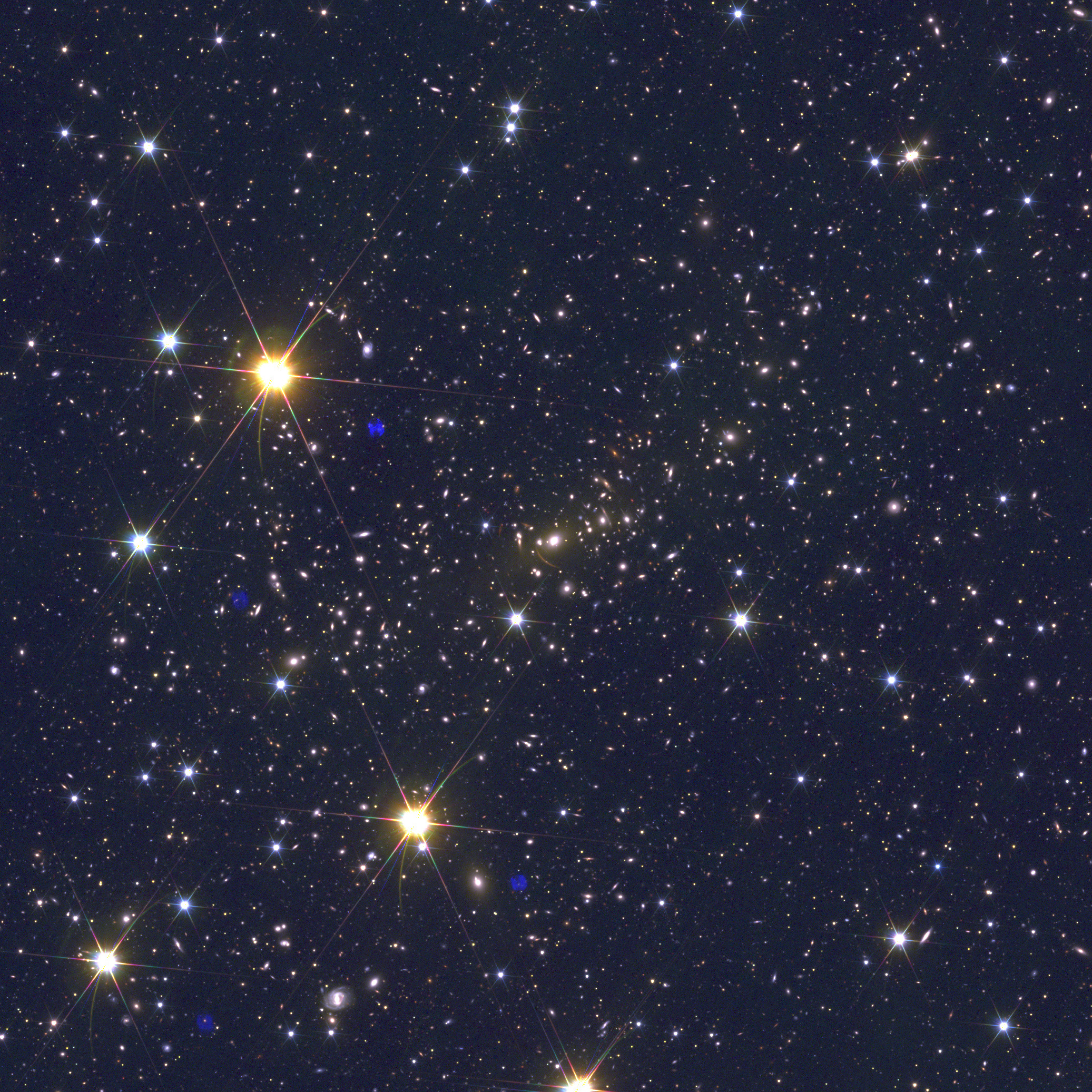
Original Euclid observation of the galaxy cluster Abell 2390, targeted as part of the Euclid Early Release Programme. A few bright stars showing typical ‘spikes’ lie in the foreground inside our Milky Way, most other points are galaxies, many of them are part of the galaxy cluster. (Note: the bright blue blobs here are image artifacts, created by internal reflections in the VIS instrument.)
Credit: ESA/Euclid/Euclid Consortium/NASA, image processing by J.-C. Cuillandre (CEA Paris-Saclay), G. Anselmi.
License: CC BY-SA 3.0 IGO or ESA Standard Licence
The researchers cannot infer weak lensing distortions from a single galaxy image, since they do not know how the galaxy looked before it was gravitationally lensed. “Instead, we measure the shapes of thousands of galaxies. Gravitational distortions, which are often called shears, can then be detected as local net alignments in the ellipticities of galaxies”, explains Dr. Giuseppe Congedo from the University of Edinburgh, who leads the development of the galaxy shape measurement method LensMC for Euclid, which was also applied here. “The Abell 2390 observations provided the first opportunity to apply weak lensing techniques to actual Euclid data. To validate the methods and test the data, we therefore applied multiple consistency checks in the analysis. For example, we repeated the full analysis using three independent galaxy shape measurement algorithms, finding good agreement between the results”, adds co-author Dr. Raphael Gavazzi from the Institut d’Astrophysique de Marseille.
Dr. Yuzheng Kang, a recent graduate from the University of Geneva, clarifies: “Only galaxies located behind the galaxy cluster are gravitationally lensed.” Kang worked on the selection of these galaxies and the estimation of their distance distribution together with Dr. William Hartley from the University of Geneva. For this the researchers measured the colours of galaxies in both the Euclid images and ground-based observations from the SUBARU telescope, and compared these to data from the COSMOS survey.
“As a further complication, we had to account for a potential contamination of the background galaxy sample by cluster members, as they dilute the lensing signal”, explains Florian Kleinebreil, who is a PhD candidate at the University of Innsbruck. “Finally, we also had to fold in calibrations from the analysis of simulated weak lensing data”, adds Henning Jansen, who is a further co-author and PhD candidate at the University of Innsbruck. What were they able to see?
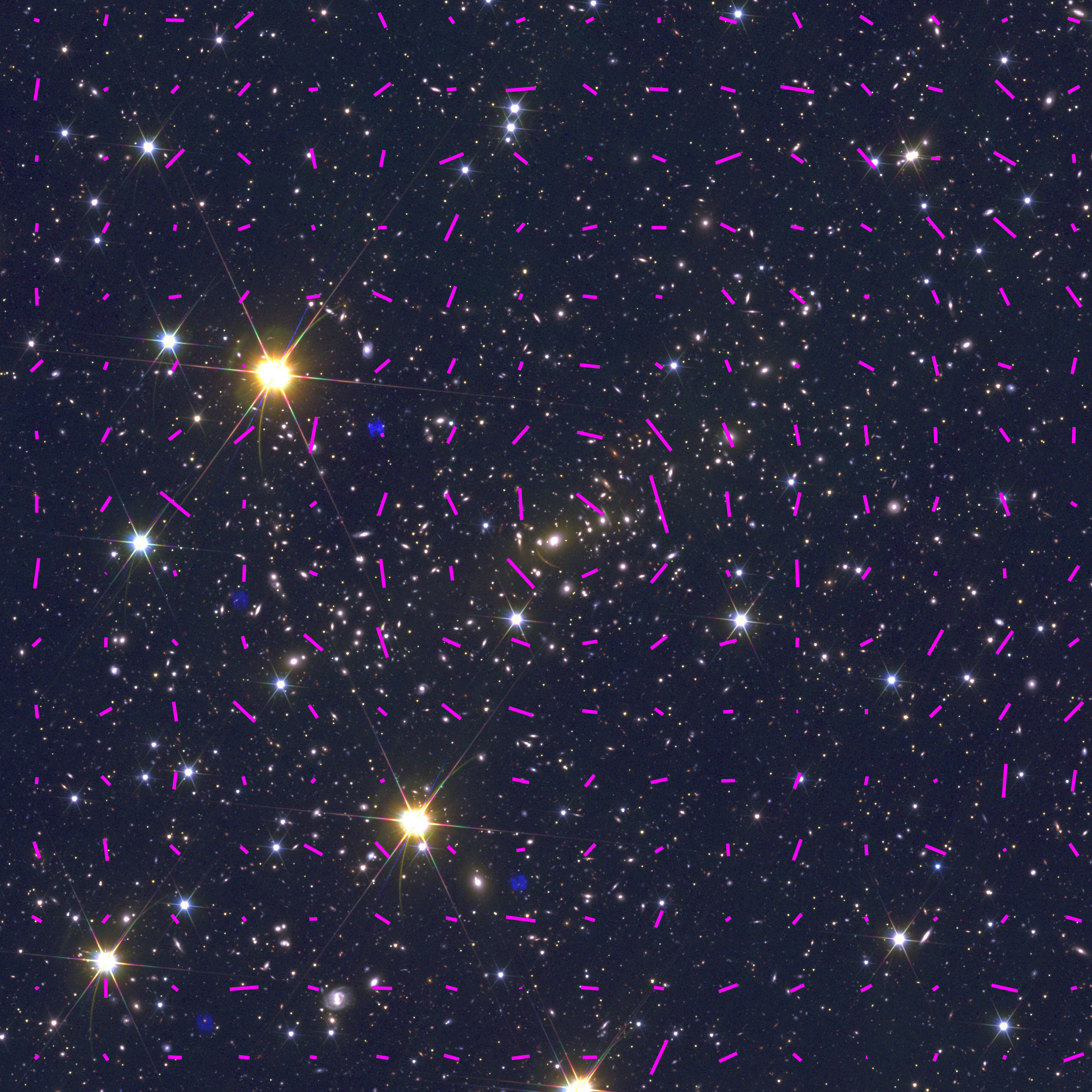
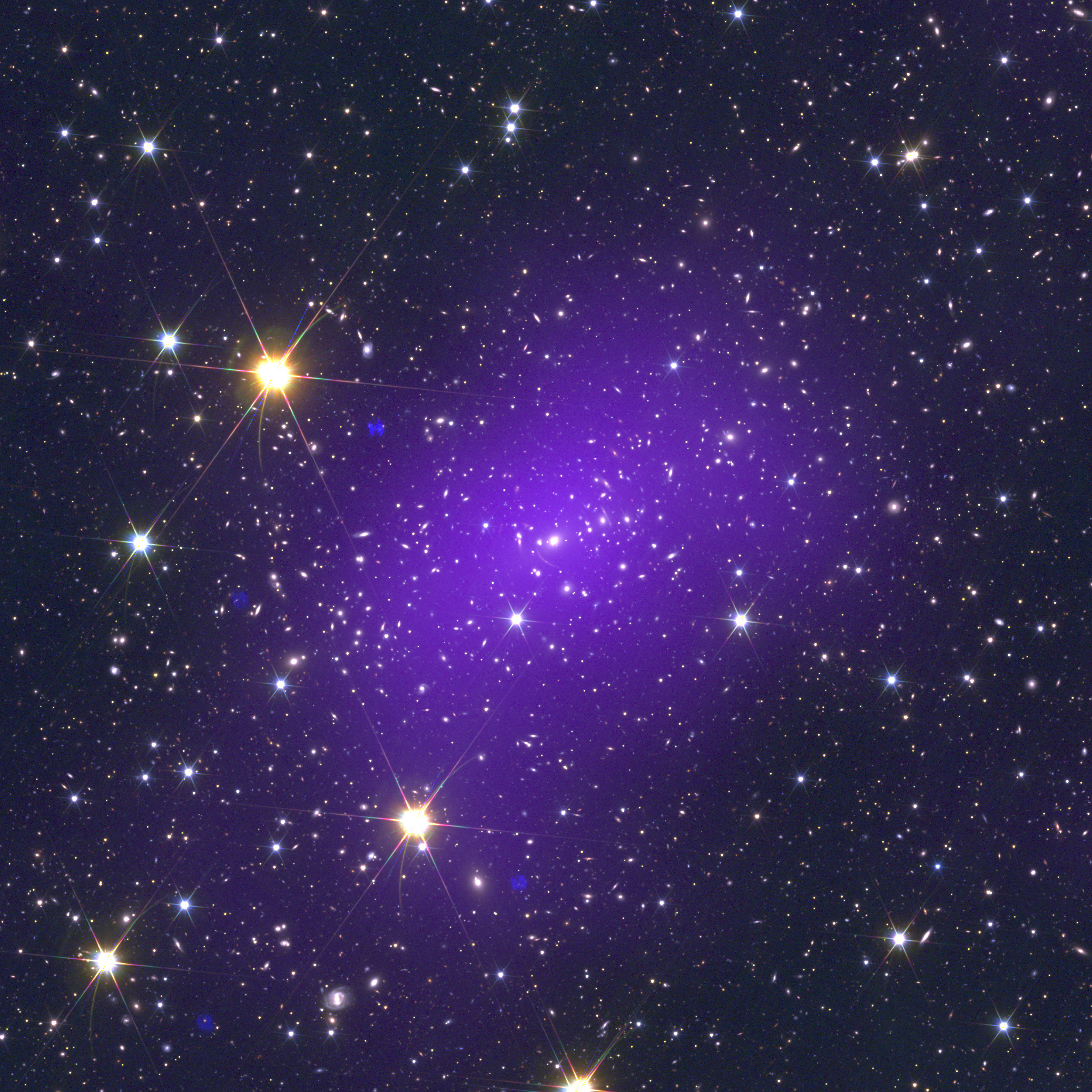
The result from Schrabback et al. is illustrated by the magenta whiskers on the left, the ‘shear’. What was measured is the mean ellipticity of background galaxies estimated by LensMC, statistically corrected for a ‘contamination’ of the signal by actual galaxies in the cluster itself. While there is still some noise from the intrinsic galaxy shapes, a coherent approximately circular pattern is visible around the cluster centre. The strength of this pattern tells the researchers about the gravitational field of the cluster and accordingly its mass: this allows them to reconstruct the mass distribution within the cluster, shown in violet on the right. “Most of this mass is caused by dark matter, which we cannot observe directly, but Euclid allows us to reconstruct its distribution with the help of gravitational lensing”, adds co-author Dr. Jose Diego from the Instituto de Física de Cantabria, who also led a companion paper that combines the new weak lensing measurements with strong gravitational lensing constraints from the inner cluster region.
So what is new about this? “Similarly sensitive weak lensing measurements have been achieved before using space-based images, e.g. from the Hubble Space Telescope. So at first glimpse there seems to be nothing special about our results”, says Schrabback. “Yet! Euclid’s 180 times larger field of view will provide similar measurements, for which our study provides a first small demonstration, but over a third of the whole sky. The Abell 2390 observations analysed in our pilot study cover less than 0.004% of the sky area that the full Euclid survey is expected to cover. Hence, there is a huge potential for scientific discoveries in the coming years, where we will use the measured weak lensing signals to trace the growth of massive structures over cosmic time, telling us more about the nature of the invisible components of the Universe, dark matter and dark energy.”
T. Schrabback et al., 2026, A&A, 708, 345, ‘Euclid: Early Release Observations – Weak gravitational lensing analysis of Abell 2390’
J. M. Diego et al., 2026, A&A, 706, 83, ‘Euclid: Early Release Observations – A combined strong and weak lensing solution for Abell 2390 beyond its virial radius‘
H. Atek et al., 2025, A&A, 697, 15, ‘Euclid: Early Release Observations – A preview of the Euclid era through a galaxy cluster magnifying lens’
G. Congedo et al., 2024, A&A, 691, 319, ‘Euclid preparation: LIII. LensMC, weak lensing cosmic shear measurement with forward modelling and Markov Chain Monte Carlo sampling’
Images:
Image credits: ESA/Euclid/Euclid Consortium/NASA, image processing by J.-C. Cuillandre (CEA Paris-Saclay), G. Anselmi.
Image credits: ESA/Euclid/Euclid Consortium/NASA, image processing by J.-C. Cuillandre (CEA Paris-Saclay), G. Anselmi.
Weak lensing constraints: Schrabback et al. (2026)
Image credits: ESA/Euclid/Euclid Consortium/NASA, image processing by J.-C. Cuillandre (CEA Paris-Saclay), G. Anselmi.
Weak lensing constraints: Schrabback et al. (2026)
Image license: CC BY-SA 3.0 IGO or ESA Standard Licence


