
Quasars are growing super-massive black holes, they are the most powerful continuous energy sources in the Universe. Quasars are a key to understanding the formation of structure in the early Universe, and can also be used as very distant background light-sources to study the distribution of gas across space. Consortium scientists have now discovered 31 new quasars in the very early Universe using the first 18 months of Euclid data, more than doubling the known numbers, including the two most distant quasars known to date.
Super-massive black holes emit radiation violently when they grow by accreting gas. This is a near inevitable consequence of a dense gas accretion disk at the outer edge of the black hole, heating up and emitting radiation caused by friction, magnetic fields, and particle interactions. The total amount of energy can be substantially more than that emitted by all the stars in the galaxy the super-massive black hole resides in, despite the stars jointly having 1000 times more mass.
While these accreting black holes, also called QSOs or quasars, have been known for many decades and studied in detail in the local Universe, one of the ‘holy grails’ in astronomy is finding quasars in the very early Universe. With masses of up to 10 billion solar masses, these black holes must have formed from accretion of matter and mergers with other black holes. This takes time. Before some point in the early Unverse there simply shouldn’t have been enough time for their formation. Finding them at earlier and earlier times and investigating their mass and environment will allow scientists to draw conclusions about the so-far unclear mechanisms of early black hole growth – and its potential impact on the formation of galaxies and generally structure at early times.
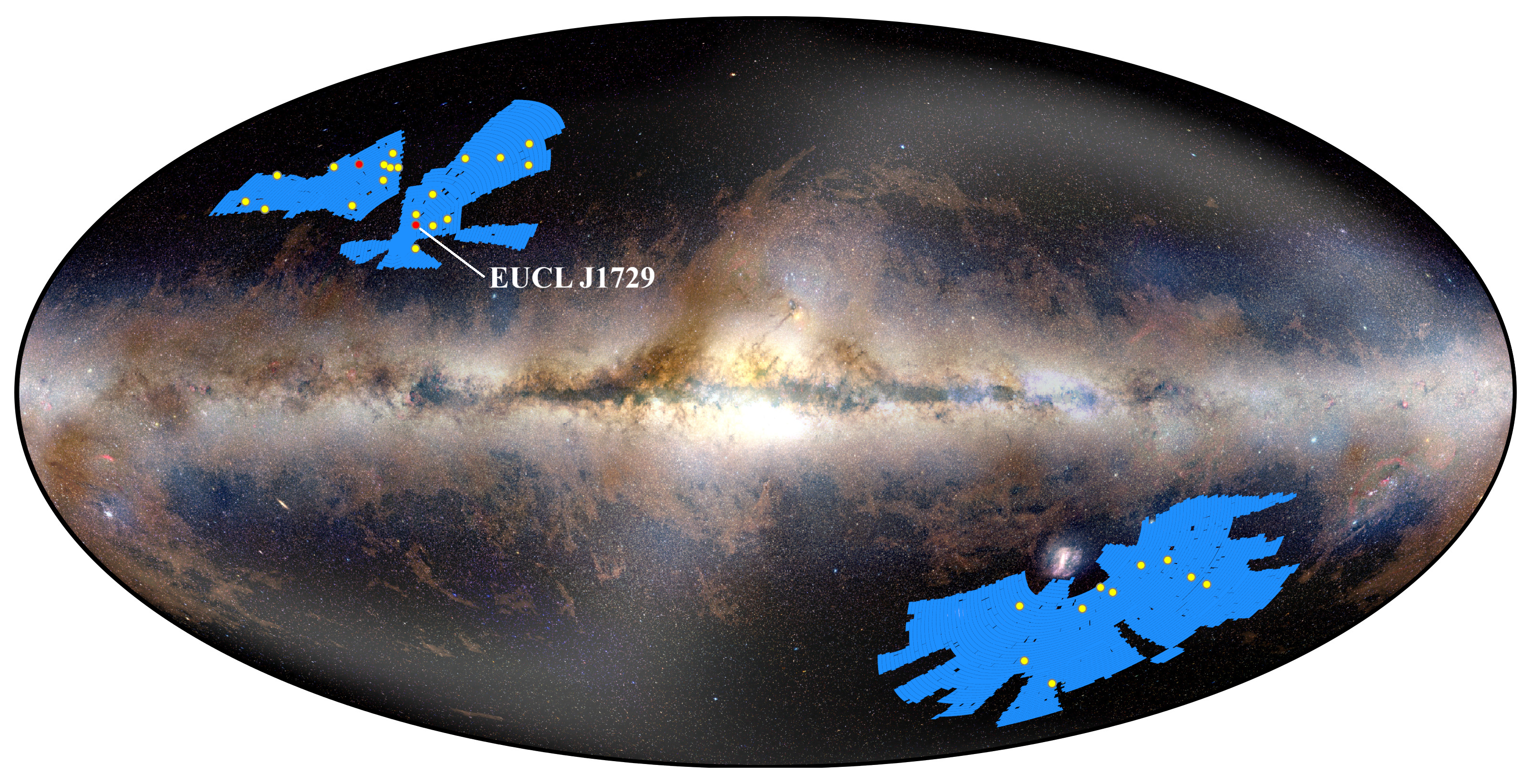
Footprint of Euclid’s survey area by August 2025 and the location of the now newly discovered early Universe quasars. Credit: ESA/Euclid/Euclid Consortium/NASA/Planck Collaboration/A. Mellinger; Acknowledgment: Jean-Charles Cuillandre, João Dinis
Up to now, quasars were found by searching in large-area ground based imaging surveys. Quasars have intrinsically very distinct blue-ish colours, quite different from most other celestial objects. When searching for quasars at larger distances, and – due to the limited speed of light – therefore back in time, their spectrum gets shifted to redder and redder colours. At some point only very red and very sensitive surveys will allow to find these rare distant quasars.
With its launch Euclid opened a new realm and hence a new era of quasar searches. With both its visible light camera (VIS) and the Near-Infrared Spectrometer and Photometer (NISP) Euclid is perfectly matched to early Universe quasars: the Euclid surveys are very deep, allowing to find faint objects, and they will eventually cover nearly a third of the sky also in the near-infrared to also search for the rare quasars. A combination impossible to achieve with Earth-based cameras.
A team of Euclid Consortium scientists has started even before Euclid’s launch to prepare for the quasar search: Euclid data will provide quasar ‘candidates’ that need extra data, and in particular spectroscopic information, to be confirmed as actual quasars, and to have their distance (‘redshift’) confirmed and potentially black hole mass measured. The team organized access to large ground-based telescopes for this task, to hit the ground running when the Euclid data start to pour in.
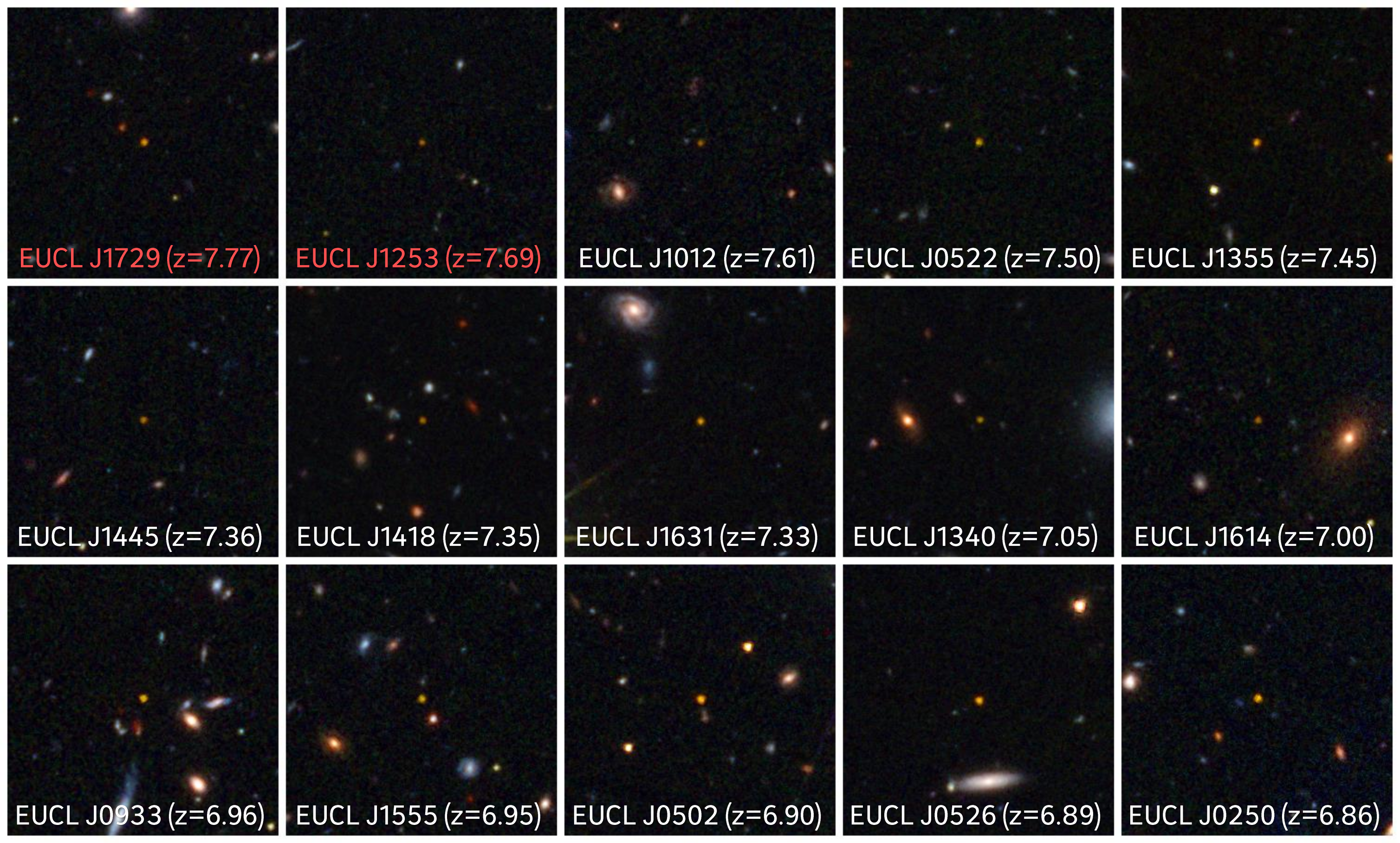
15 of the 31 newly discovered quasars, with the two new distance record holders on the top left, each centered on a quasar. Looking just like a little dot illustrates why they are so hard to identify: only a few of almost a billion objects so far imaged by Euclid are such quasars. Identification is a complex needle-in-the-haystack situation, which Euclid scientists successfully mastered.
Credit: ESA/Euclid/Euclid Consortium/NASA, image processing by the Euclid Science Ground Segment and Antoine Basset (CNES)
The search was successful: using Euclid data from its first 1.5 years, early-Universe quasar candidates were selected, graded by quality, then followed up with these large ground-based telescopes. In two papers, now published by Astronomy & Astrophysics, the results are reported: In a discovery paper 31 new early Universe quasars are presented. Euclid data led to more than doubling the number of known quasars beyond redshift z=7, an epoch when the Universe was a mere 750 million years old. This project also discovered the two currently most distant known quasars, the furthest at z=7.77, seen at only 670 million years after the Big Bang.
The second paper takes the analysis one step further and studied the second-most distant quasar found with Euclid using the NOEMA submillimeter telescope. This allowed to analyse the gas and dust environment of the quasar’s host galaxy, providing a first insight into the conditions in which super-massive black holes in the early Universe grow.
These are the result of an initial search in only a third of Euclid’s total planned data, and with only the most probable candidates being followed up. Hence much more is expected to come from Euclid in the next years. There is hope to find even more distant quasars beyond z=8 and possibly z=9, another 20% closer to the beginning of the Universe.
You can find more background on this project in our Euclid Consortium press release, the ESA press release, and in the two published papers, available as open-access publications at A&A:
- Discovery paper: Yang et al., 2026, A&A, 711, 104
- Follow-up analysis: Belladitta et al., 2026, A&A, 711, 150


