
There are potentially one trillion (1,000,000,000,000) comets flying across our solar system. Made of materials that will melt or vaporize and outgas when being brought to the Sun, comets originate from the far reaches of our solar system, in the Oort Cloud way beyond the last major and minor planets. Of all the possible comets out there, only 4644 have come close to the sun – and actually been observed by humans. Now scientists have added one more, the first found with Euclid data: ‘C/2026 S1 (Euclid)’.
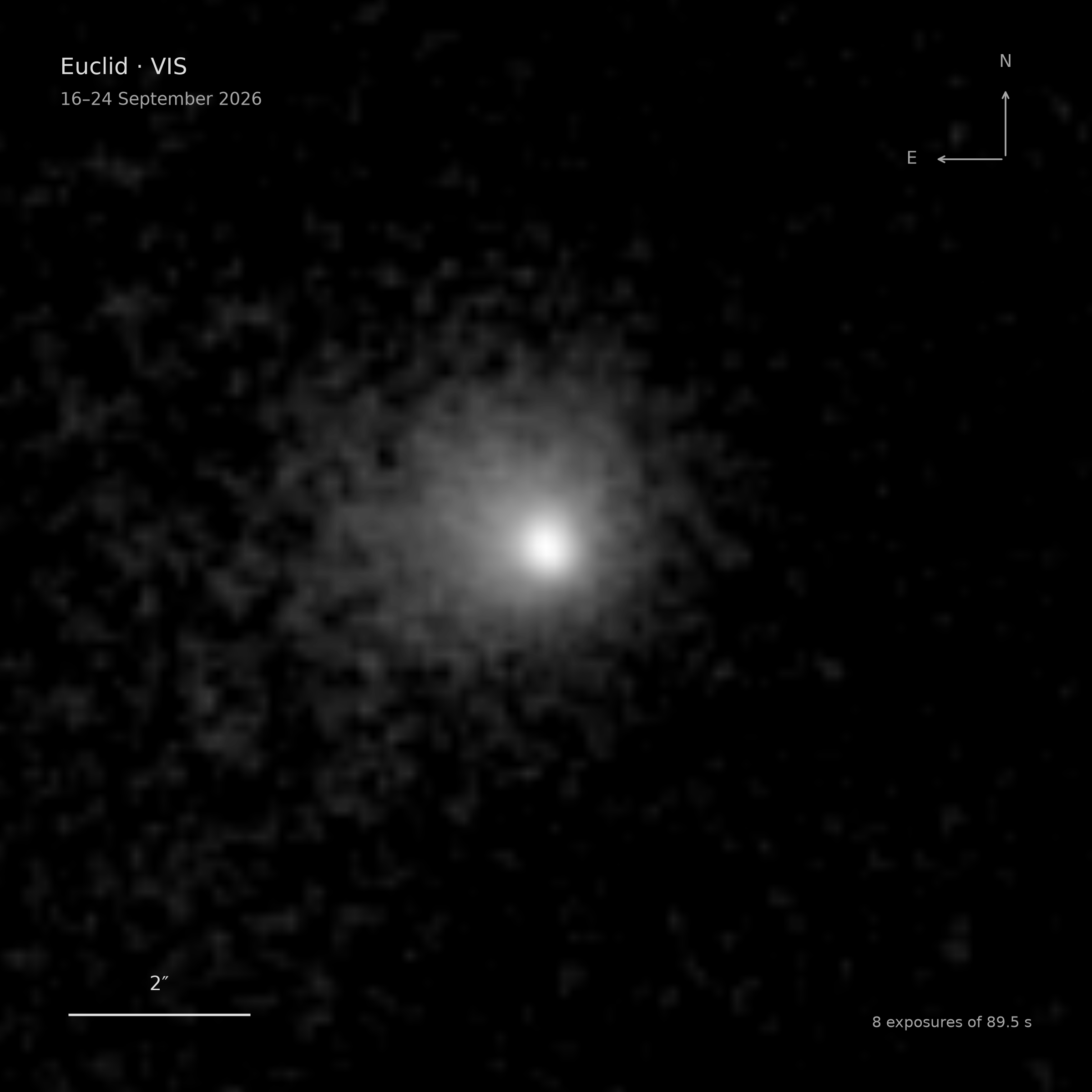
Image combined from a stack of eight 90s exposures from Euclid’s VIS camera, showing the newly discovered comet ‘C/2026 S1 (Euclid)’.
Credit: ESA/Euclid/Euclid Consortium/NASA, M. Pöntinen et al. 2026
Comets, ‘dirty snowballs’ as they are sometimes described, are frozen solid when far away from the Sun, but might warm up enough to develope their long, very visual tails that make them so fascinating to look at. The most famous: Halley’s comet, coming back to Earth every 76 years with its first recorded sighting in 240 BC. ‘1P/Halley’ is the first in the list of short-period numbered comets. They share having been observed in at least two epochs, that they’ve come back to the central solar system once more after their initial discovery. Only a good 500 numbered comets are there to date, requiring a ‘short’ orbit, currently ranging from 3 to over 300 years, to be seen at least twice since humans have been observing the skies. But as we will see below, ‘C/2026 S1’ has a, let’s say, slightly longer period.
Asteroids and comets are frequently observed in astromical sky surveys. They stand out against stars or galaxies by moving relative to all these background object. Which is what they do: they move rather quickly through the solar system, being visible only for a few weeks or months, then having moved further out again. The Euclid Consortium’s Solar System Objects Science Working Group have turned Euclid’s survey data into a search space for such moving objects. Within the working group Mikko Pöntinen (University of Helsinki) and collaborators had developed software to detect ‘streaks’ in Euclid images. Since Euclid keeps the reference frame of stars fixed and steady for the duration of observing each patch of the sky – which takes up to 10 minutes per position – any asteroid or comet will leave a streak of light from its motion during this time. Sometimes such a streak will be too short to identify, but if the motion is fast enough, it can be found.
Mikko Pöntinen’s software set out to do this automatically, which is the only feasible way to comb through Euclid’s eventual 100 trillion pixels worth of information. Many discoveries will actually be ‘re-discoveries’, instances of detecting known asteroids or comets again – Euclid data is predicted to contain 150.000 asteroids. But for the much smaller number of comets the statistics are very different.
The image in which C/2026 S1 was then first detected shows exactly such a small streak, a shape very different from any star or galaxy that Euclid images by the thousands:
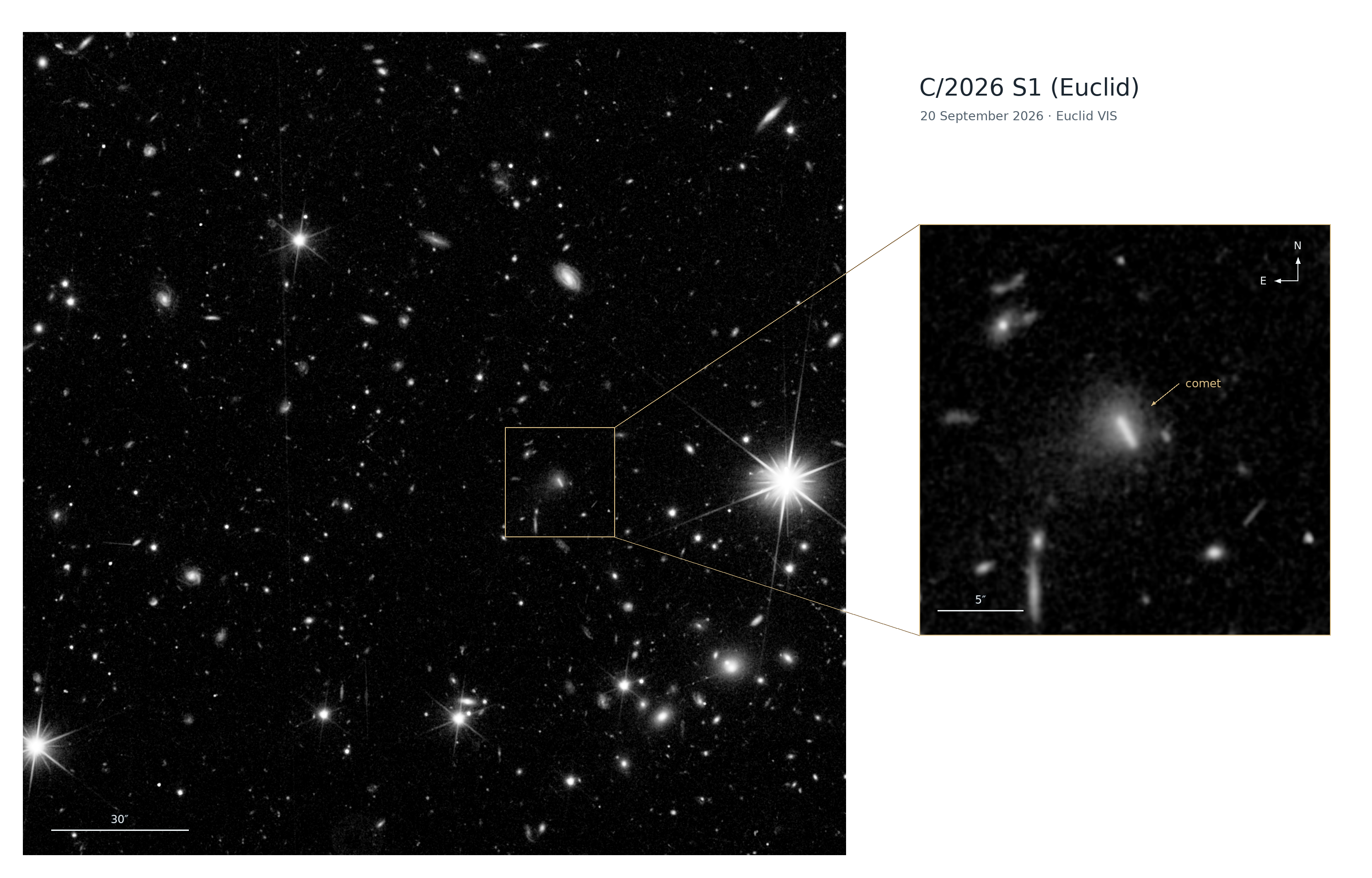
Credit: ESA/Euclid/Euclid Consortium/NASA, M. Pöntinen et al. 2026
A comet! But this also shows the challenges for this endeavour, such a needle has to be identified in a haystack of many millions of other celestial objects.
The shorter snapshot of the same location as shown in the first image at the top of this page doesn’t give the comet much time for moving, so we get a sharper view: a compact nucleus and a ‘coma’ of evaporating water and small particles. If on the other hand we combine several longer images into a sequence, we can actually see the comet moving across the sky:
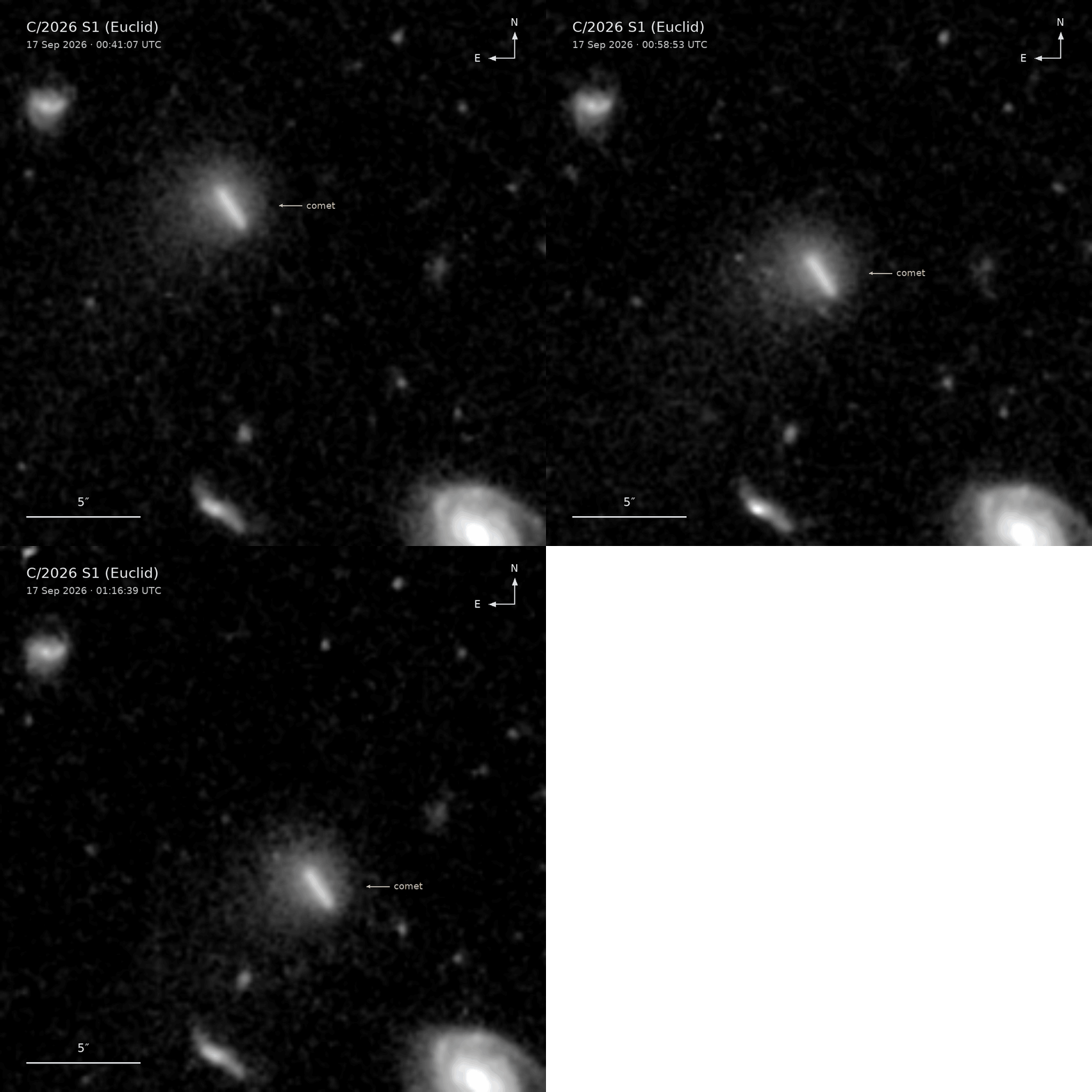
Credit: ESA/Euclid/Euclid Consortium/NASA, M. Pöntinen et al. 2026
This basically proved this object to be an actual comet. But was it a new one? There was only one way to find out: compare it to the predicted positions of all known comets. For this, the International Astronomer Union’s ‘Minor Planet Center’ is the official keeper of records: they store coordinates and orbits of all comets, and also the history of who discovered a comet or asteroid where and when. Result: it checked out, this comet wasn’t known before, a new discovery, that is now being announced by ESA.
The team then used these multiple observations of the comet in different Euclid images plus follow-up observations by other observers on the ground to establish its orbit. They traced its movement over several days, to calculate where it was moving at which velocity, how far from the sun it would eventually fly, and when it would come back the next time.
The result? C/2026 S1 is definitely not a short period comet. It will fly outward from the sun by 9786 ‘astronomical units’, i.e. the distance of Earth from the Sun. This corresponds to 1.5 trillion kilometers or 0.15 light years! This means its origin, and next destination, lie in the far-away Oort Cloud. It will only come back in about 345,000 (three hundred and fortyfive thousand) years!
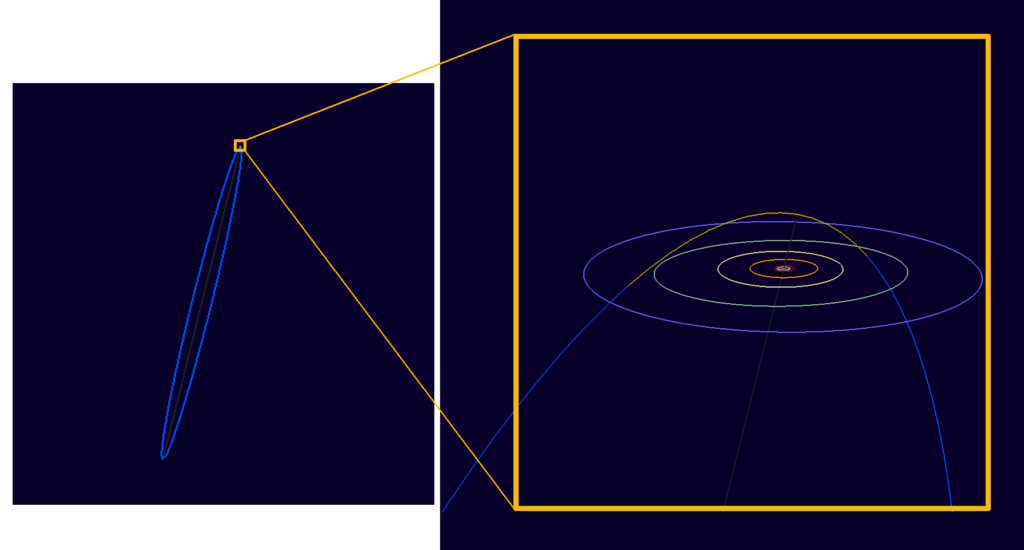
Sketch of the orbit C/2026 S1 is on: a very elongated ellipse perpendicular to the plane of the solar system’s planets (coloured ellipses shown on the right). It will move away from the vicinity of the inner solar system over time, spending 100s of thousands of years very far away in the outskirts of the solar system.
Credit: visualisations by the Minor Planet Center, collage by K. Jahnke
With this period, C/2026 S1’s last visit to the inner solar system happened during the late Middle Pleistocene, when auerochsen, wooly mammoths, and forest rhinos roamed central Europe. The Neanderthal humanoid roamed alongside them, but were just about to be displaced by the starting Saalian (elsewhere: Riss, Wolstonian, Illinoian) glacial period, eventually covering half of the northern hemisphere in ice, while our homo sapiens ancestors were starting to thrive as hunters and gatherers in northern Africa.
In the distant future ‘C/2026 S1 (Euclid)’ will eventually come back to the inner solar system and to a very different planet Earth. In the more near future Euclid scientists will continue to search for more of these messengers of ancient times and the solar system’s distant outskirts. And today we celebrate the discovery of this first new comet!
Further resources on this comet discovery:


